Broaching Cutting Oils & Coolants
Understand linear and rotary broaching, identify material challenges, and evaluate lubrication for the complete application.
Watch: Broaching — Process, Materials & Fluids
Original illustrative photographs and schematic diagrams. No customer test results are implied. English captions and a full transcript are available.
Broaching: Process, Materials & Fluids
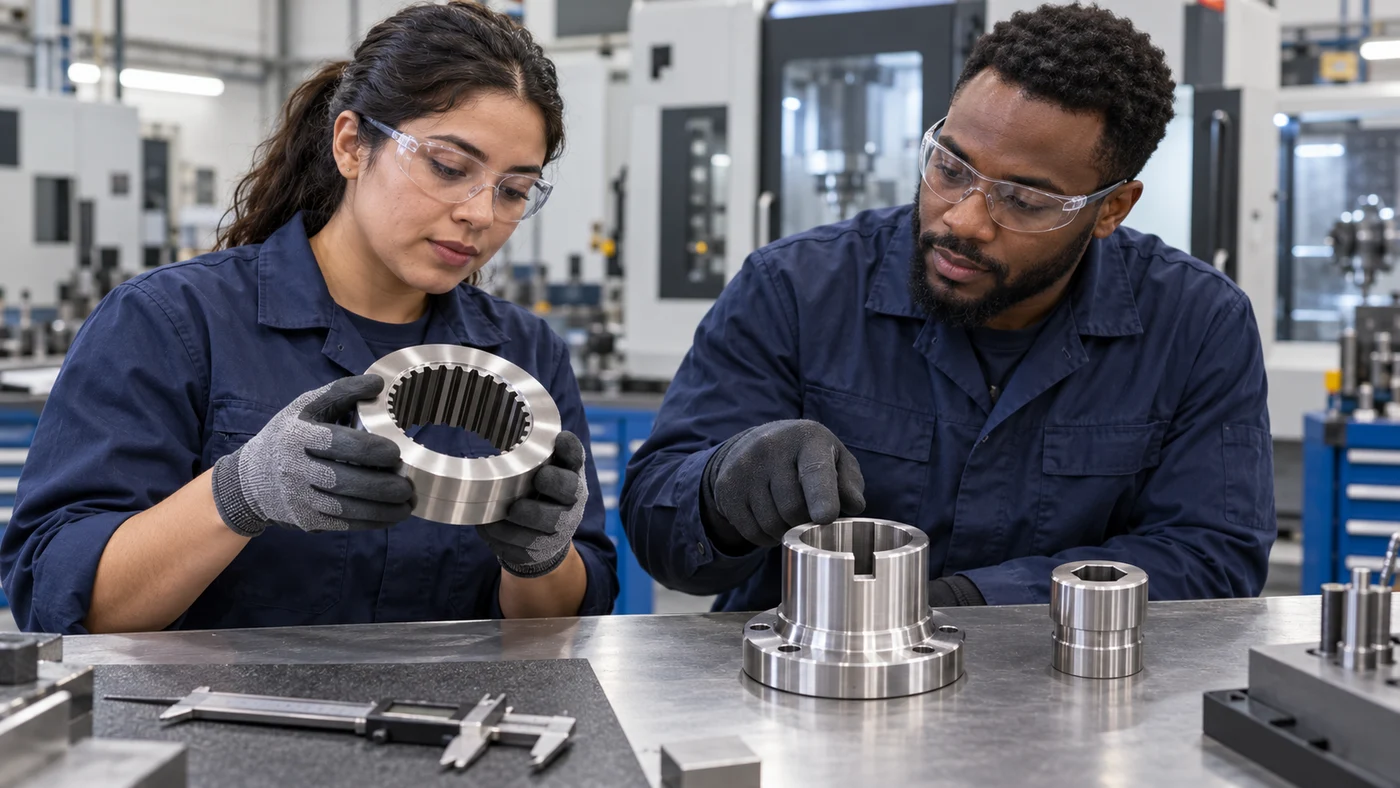
What cutting oil should you use for broaching? The answer starts with a different question. What kind of broaching are you doing, and what metal are you cutting? A press cutting a keyway, a production machine pulling an internal spline, and a rotary tool making a hexagonal socket do not all put the same demands on a fluid. In this QA Lubricants training video, we explain the main broaching processes, the materials that make them challenging, and how to evaluate cutting oils and water diluted coolants. Our goal is to help you recognize the application, ask the right questions, and make a controlled fluid selection. The photographs in this guide are original illustrative images. The diagrams explain principles and are not machine setup instructions. Actual tool geometry, settings, guarding, and fluid requirements must come from your equipment and tooling documentation. Let's begin with the finished part. A keyway locates a key, a spline transmits torque through multiple teeth, and a polygonal socket can provide a drive feature. Broaching is one way to produce these accurate forms.
How Conventional Broaching Works
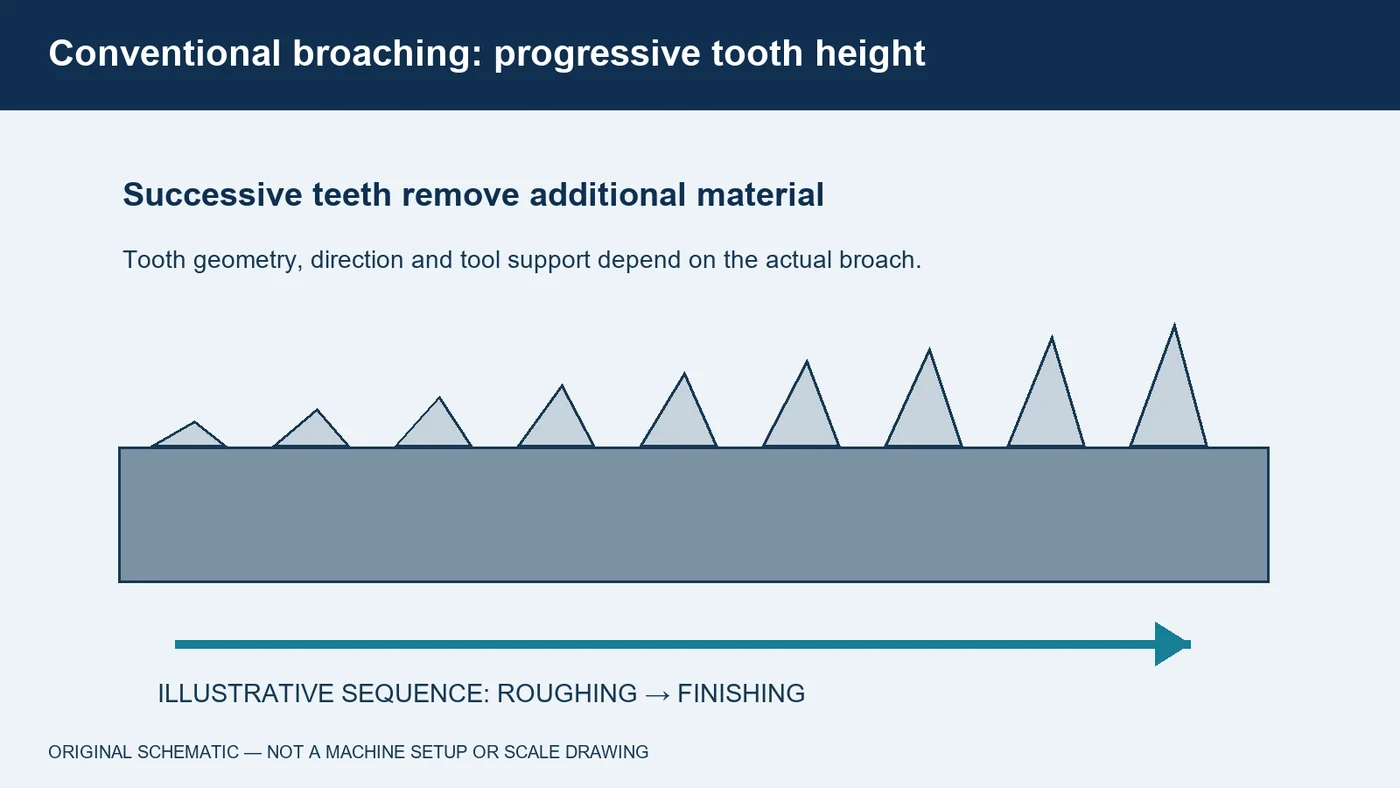
In conventional linear broaching, a multi tooth cutting tool moves through or across the workpiece. Successive cutting teeth remove additional material until the required profile is produced. A tool may include roughing, semi finishing, and finishing sections. The spaces between the teeth, called gullets, have to accommodate the chips produced during the cut. Internal broaching usually begins with a prepared opening. External or surface broaching cuts an exposed surface. The tool design, the amount removed by each tooth, and the length of engagement all affect cutting force and chip capacity. The lubricant needs to reach the working surfaces rather than simply wet the outside of the machine. Tool alignment, support, and fixture rigidity also matter. If a broach is forced out of alignment, changing coolant alone will not correct the setup. Think of the fluid as one part of a system that includes the work material, tool, fixture, machine, and chip handling. The simple diagram illustrates tooth progression. It does not prescribe tooth rise, clearance angles, stroke direction, or machine settings.
Pull, Push, Surface & Pot Broaching
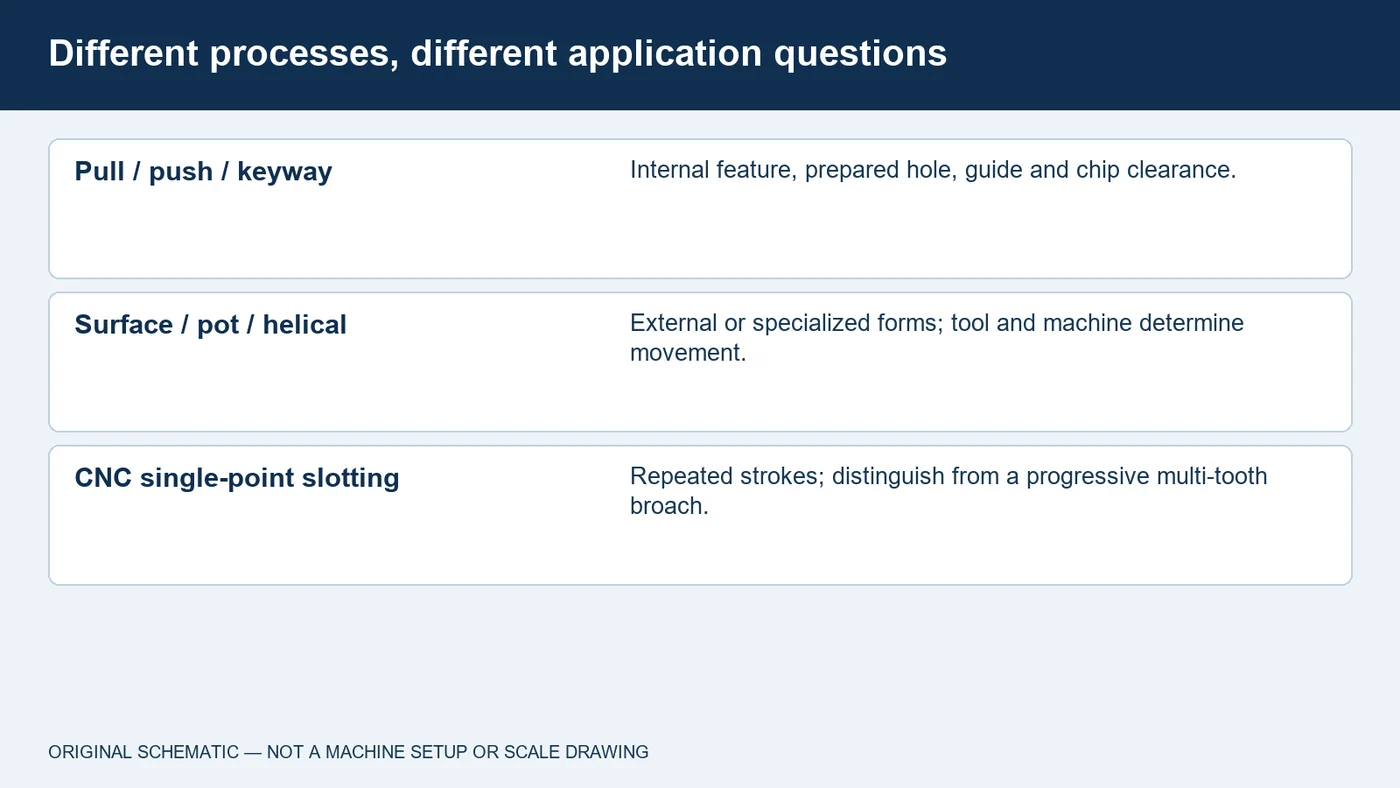
A pull broach is drawn through a component, often to produce an internal profile such as a spline. A push broach is driven through the work, with the tool supported for the application. Keyway broaching commonly uses a guide bushing and the specified shims to increase the depth over successive passes. Surface broaching produces features such as flats, slots, and external contours. In pot broaching, cutting elements surround the outside of the workpiece. Helical broaching produces a form that requires coordinated movement appropriate to the tool and feature. A CNC machine may also cut a keyway by repeated single point strokes. That is different from removing the complete profile with a conventional multi tooth broach. These distinctions matter when describing a customer's problem. Ask whether the feature is internal or external, through or blind, and whether the tool is pulling, pushing, rocking, or making repeated strokes. Then ask how the cutting fluid is delivered and where the chips go. A process name alone is not enough to select the right oil.
Rotary Broaching Is Different
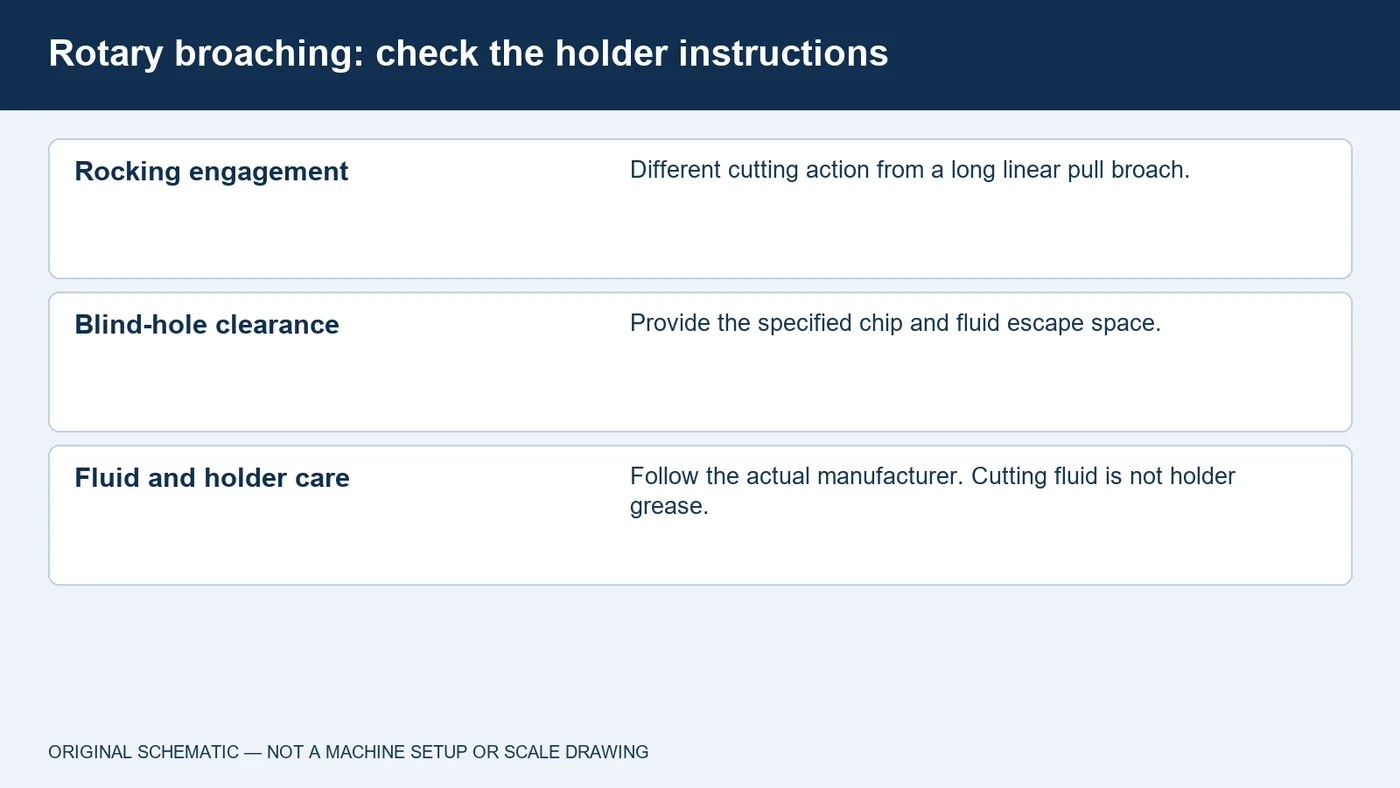
Rotary broaching, sometimes called wobble broaching, uses a holder and tool arrangement that engages the cutting form progressively as it feeds. It is often used to produce polygonal features on a lathe or machining center. Its engagement differs from a long linear pull broach, so its lubrication needs should be evaluated separately. Published tooling guidance is not identical. Slater Tools accepts conventional water or oil based fluids for its rotary broaching applications, while Somma Tool expresses a preference for oil based coolant where possible. The practical lesson is to follow the instructions for the actual holder, broach, material, and feature. Blind holes require particular attention. Chips and displaced fluid need somewhere to go. Filling a blind pilot hole with liquid can prevent the tool from reaching its intended depth. Follow the tool maker's directions for applying fluid and providing chip clearance. Do not try to overcome a blocked or hydraulically trapped tool by adding force. Stop and evaluate the setup. Holder grease is also separate from the cutting fluid; use the holder's specified maintenance procedure.
What Makes a Cut Severe?
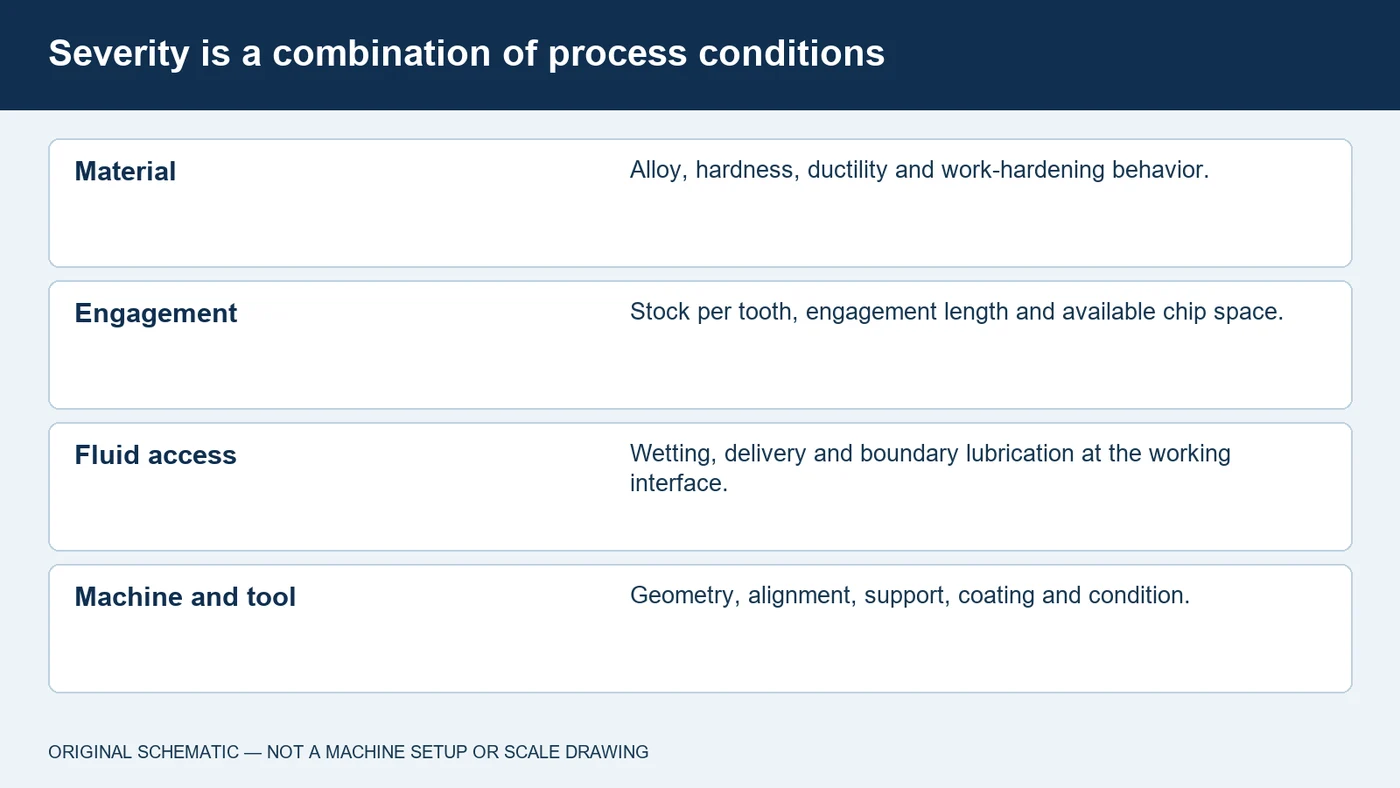
Broaching can demand strong lubrication, particularly when a difficult material, substantial engagement, and limited fluid access occur together. But severity is not a single number attached to every broaching machine. Material strength and heat treatment change the resistance to cutting. Some ductile materials tend to smear or adhere to the edge. Other alloys work harden, making an ineffective cut more difficult. Several cutting teeth may be engaged at once, while chip packing or poor delivery can prevent fluid from reaching the interface. Boundary lubricity helps reduce friction where a full fluid film is difficult to maintain. Extreme pressure additives can provide additional protection under suitable contact conditions, depending on the formulation. A thicker oil is not automatically a stronger cutting oil. Additive chemistry, wetting, filterability, oxidation resistance, and machine compatibility all influence performance. If a shop reports short broach life, look at the complete pattern. Is the damage consistent across teeth? Are chips clearing? Has alignment or material condition changed? Measure those factors before assuming that one stronger additive or a viscosity change will solve the problem.
Match the Fluid to the Material
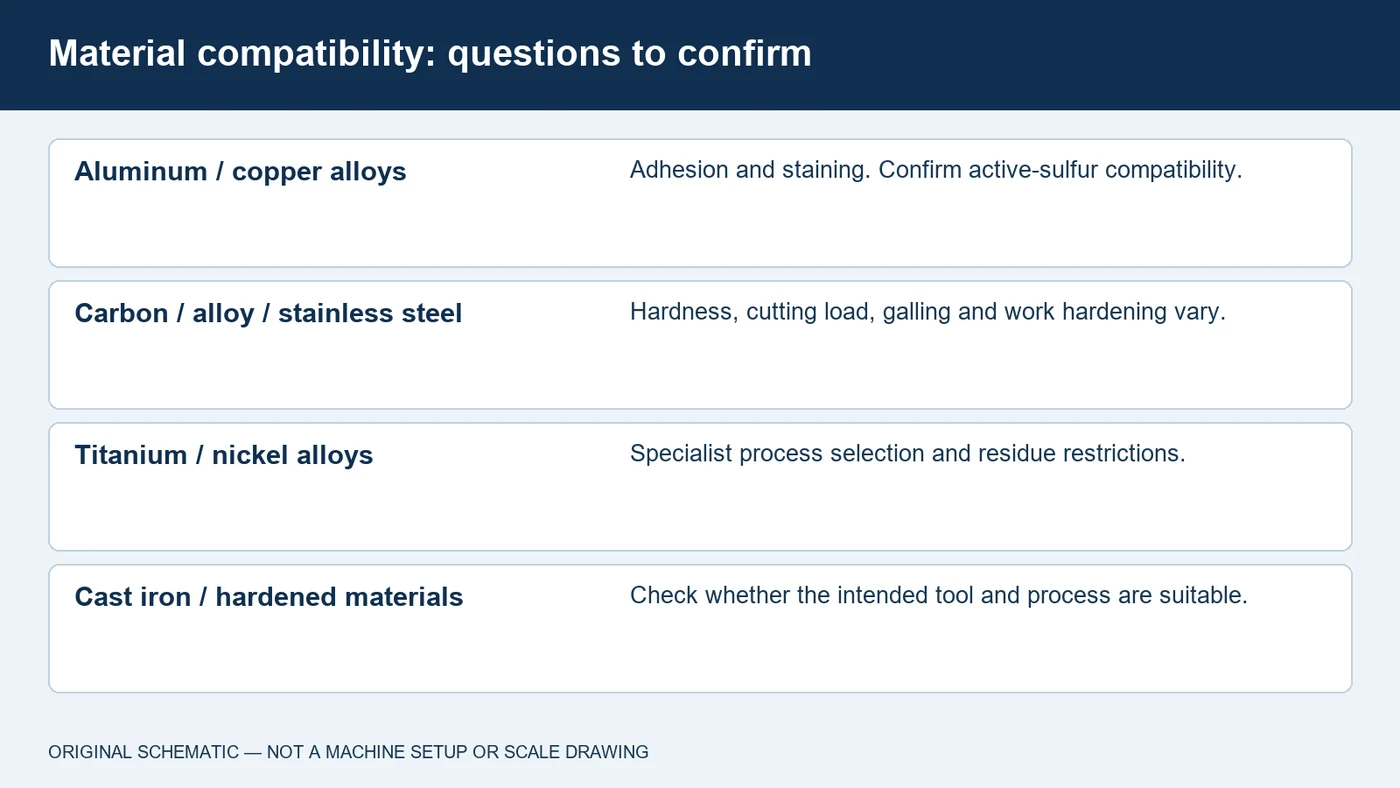
Aluminum broaching calls for a fluid compatible with the exact alloy, with attention to adhesion, finish, and staining. Copper, brass, and bronze require special care with additive selection because some active sulfur formulations can discolor copper containing materials. Do not assume that every fluid sold for steel is suitable for yellow metals. Carbon steel and alloy steel can need different levels of lubricity depending on strength, hardness, geometry, and stock removal. Stainless steel adds concerns such as adhesion and work hardening, and heat treatment can substantially change the application. Hardened steels require confirmation that the proposed broaching tool and process are suitable at all. Titanium and nickel alloys should be treated as specialist applications, including any restrictions on chemical residues or downstream processing. Cast iron has its own abrasive chip and dust considerations, and a process may be designed for dry cutting or for a specified fluid. Never translate this material overview into a universal lubricant approval. Record the alloy designation, hardness, tool material and coating, feature dimensions, and finish requirements. Those details turn a general discussion into a useful recommendation.
Cutting Oil or Water-Diluted Coolant?
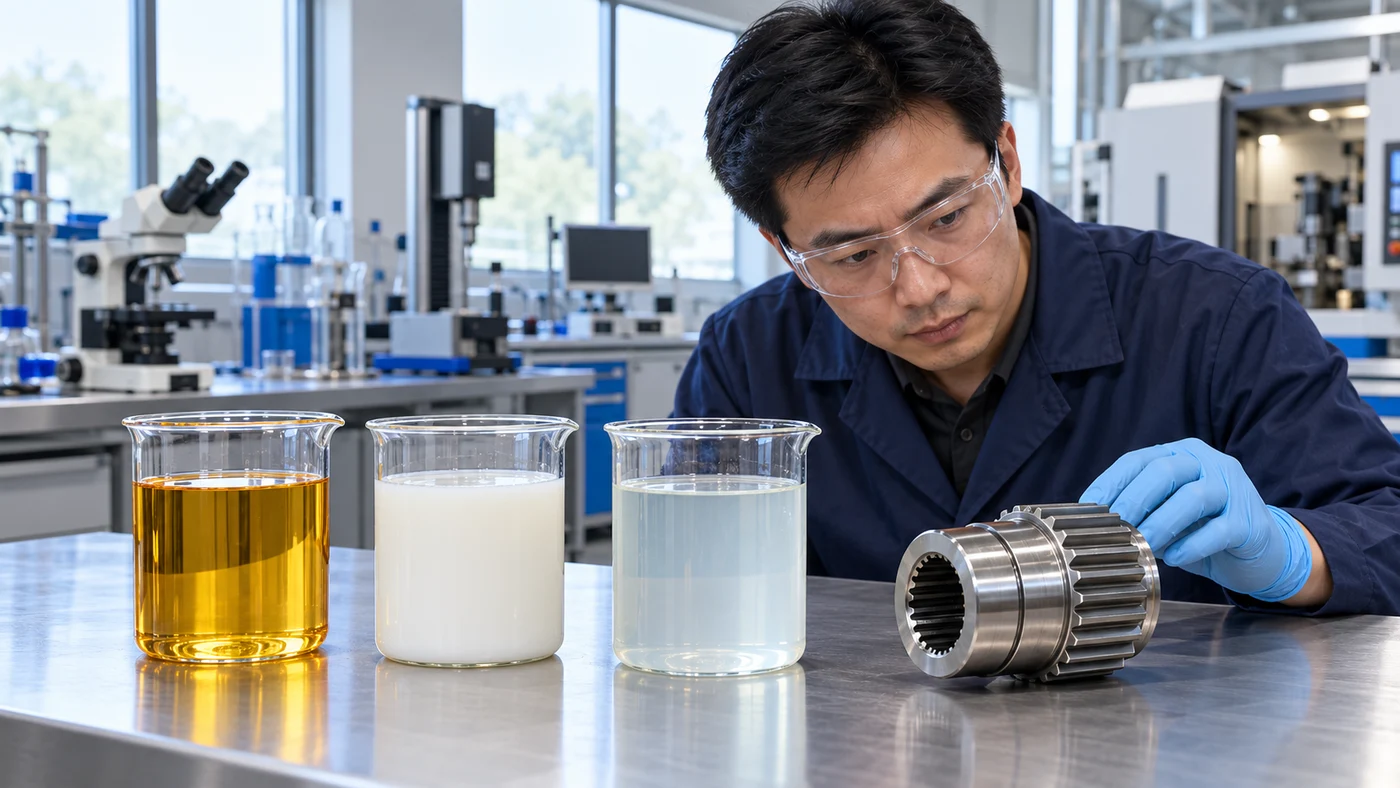
Straight cutting oils are used without water dilution. They are often evaluated where boundary lubrication, finish, and strong cutting performance are priorities. Water diluted products include soluble oil emulsions, semi synthetic coolants, and full synthetic formulations. They can offer useful cooling and chip transport, but the actual product needs enough cutting performance for the operation. Specialist water miscible fluids have been developed for demanding broaching, so it would be incorrect to say that every broaching application must use neat oil. It would be equally incorrect to say that every synthetic coolant is suitable. The specific formulation matters more than the family name alone. A shared machine sump creates another question: will the fluid also support the turning, milling, drilling, or tapping operations on that machine? Compare the complete process and maintenance requirements. The appearance of a beaker, whether amber, milky, or translucent, does not prove its lubricity or suitability. Evaluate material compatibility, approved application guidance, concentration where relevant, foam behavior, filtration, and how easily the finished part can be cleaned.
Delivery, Filtration & Fluid Condition
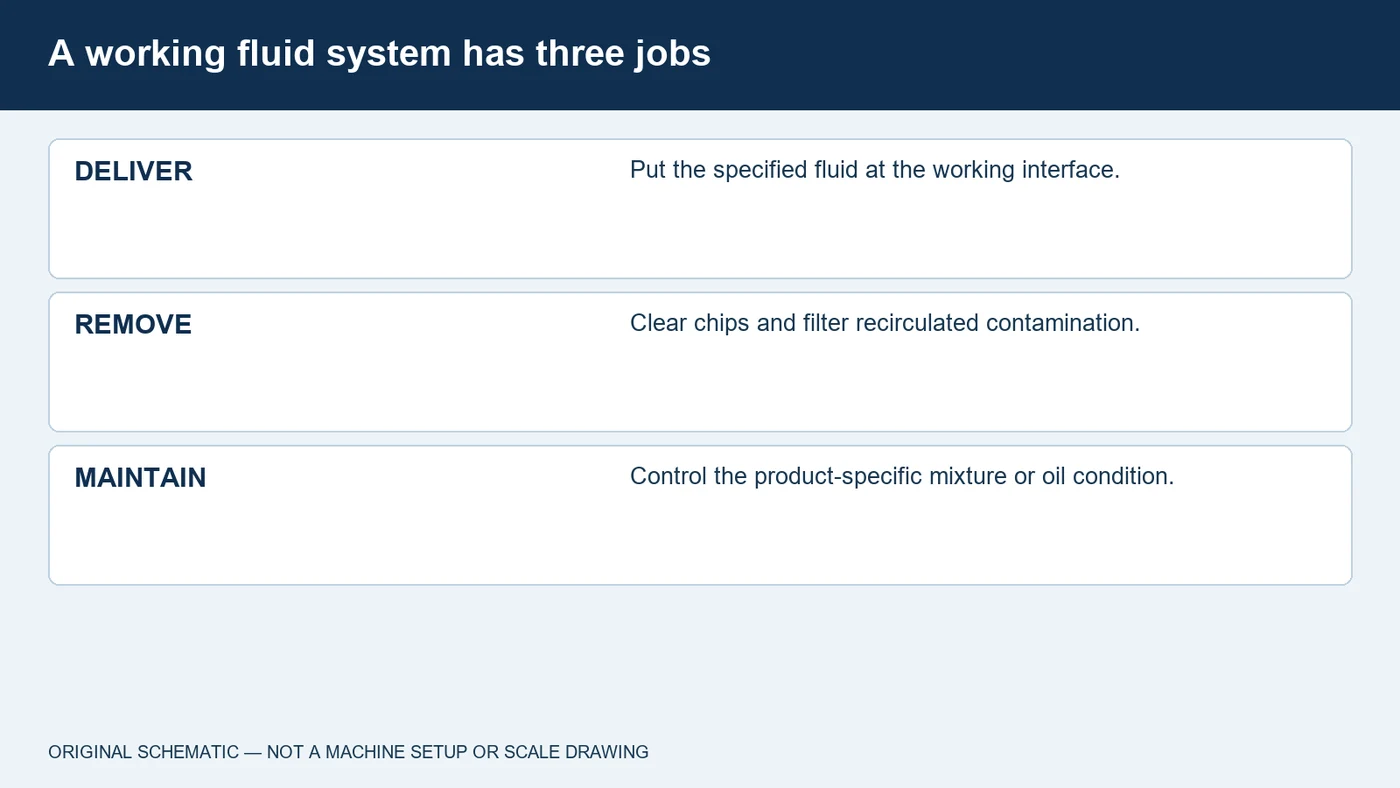
Good fluid selection can be undermined by poor delivery. Inspect the nozzle location and flow path using the machine's safe inspection procedure. A stream that looks impressive outside the tool may not reach the loaded teeth. Chip handling is equally important. Recirculating dirty fluid can carry abrasive fines back into the process, while packed gullets reduce the available space for fresh chips. Choose filtration that matches the tool, fluid, chip size, and machine requirements rather than an arbitrary universal micron rating. For water diluted coolants, maintain the supplier's recommended concentration for the particular product and application. Calibrate the refractometer and apply the correct product factor. Mix concentrate into water using the specified method. Review make up water quality, corrosion protection, contamination, and the condition of the sump. Straight oils need their own checks, including contamination, viscosity changes, filtration, and mist control. Establish a routine record of checks instead of waiting until a tool fails. Never use coolant color or odor as the only test of condition, and never change delivery pressure beyond the limits of the machine and tooling system.
Fluid starting points by material
Use these as selection questions, not blanket product approvals. Verify the specific tool, alloy, hardness and current fluid data sheet.
| Material | Fluid properties to evaluate | What to confirm |
|---|---|---|
| Aluminum | Nonstaining lubricity and adhesion control; suitable neat oil or water-miscible coolant | Exact alloy, finish, compatibility and downstream cleaning |
| Copper, brass and bronze | Nonstaining fluid; verify active-sulfur compatibility | Grade, discoloration tolerance and residue requirements |
| Carbon and alloy steel | Cutting performance appropriate to strength and tooth engagement | Hardness, stock per tooth, chips and delivery |
| Stainless steel | Strong boundary lubrication appropriate to the application | Adhesion, work hardening, tool condition and alloy |
| Titanium and nickel alloys | Specialist fluid selection and controlled trials | Tool maker guidance, chemical restrictions and process requirements |
| Cast iron or hardened materials | Fluid or dry-process choice specified for the tooling | Process feasibility, abrasives, chip/dust handling and machine design |
Discuss a broaching oil or coolant with QA
Send the operation, alloy and hardness, tool type, hole depth, blind/through condition, current fluid, delivery method and the problem you want to solve. We will use those details to narrow the product candidates.
Discuss my applicationVisit the QA storeQA Lubricants offers coolant and cutting-oil options for broaching and other metalworking applications. Contact our team to match the fluid to your operation, material and equipment.
Broaching questions
Does broaching always require straight cutting oil?
No. Both neat oils and purpose-designed water-miscible fluids are used. Suitability depends on the method, material, tool and operating conditions.
Is a thicker broaching oil always better?
No. Lubricity, additive chemistry, wetting, flow, filtration and compatibility matter along with viscosity.
Can I fill a blind hole with coolant before rotary broaching?
Follow the exact tool maker's instructions. Trapped fluid can prevent the tool from reaching depth; provide the specified chip and fluid clearance.
Can one coolant cover turning and broaching?
Possibly, but check the needs of every operation sharing the sump, and verify the chosen formulation with the tool and fluid suppliers.
Video transcript: troubleshooting and selection
Troubleshoot Before Changing Products
When finish deteriorates or a broach wears prematurely, start with a repeatable record. Note the material lot, hardness, tool condition, machine settings, fluid concentration or oil condition, delivery, and number of acceptable parts. Galling or built up material can point toward lubrication or compatibility, but tool geometry and cutting conditions also deserve attention. Chatter or inconsistent dimensions may involve alignment, support, wear, or fixture rigidity. Scratches can be associated with trapped chips or recirculated fines. A process that changed after a new material batch should be checked for differences in machinability before the fluid is blamed. Use a controlled trial when evaluating a new oil or coolant. Keep the process variables comparable, set acceptance criteria, and track tool life, finish, dimensional results, fluid use, and cleaning requirements. Do not claim an improvement from a single attractive part or an unmeasured before and after picture. The goal is a reliable process and a defensible cost per acceptable part. Correct guarding, safe chip handling, and suitable mist control remain part of the job.
Build Your Broaching Fluid Recommendation
To discuss a broaching lubricant with QA Lubricants, tell us the type of broaching, the metal and hardness, the tool and coating, the feature depth, and whether the hole is blind or through. Explain how fluid is delivered, how chips are removed, and whether other operations share the same sump. Then describe the problem you want to solve: short tool life, galling, poor finish, difficult cleaning, foam, or another concern. We can use that information to evaluate suitable straight cutting oils or water diluted coolant candidates and identify what needs a shop trial. A multi metal product description is a starting point, not approval for every operation on every alloy. Confirm the current product data sheet, concentration instructions, machine compatibility, and any customer process requirements before making a change. Our website links this guide to the relevant cutting oil and coolant information, and our team can help narrow the selection. Visit QA Lube dot com or call one, eight seven seven, eight seven seven, six two two one. Thank you for watching this QA Lubricants machining guide.
Technical references
- Rotary broaching fluid and blind-hole delivery
- Rotary broaching method and oil preference
- Linear broaching and coolant/tool design
- Broaching fluid families
- QualiChem straight oil application guide
Manufacturer guidance is paraphrased into original educational content. Trademarks belong to their owners. No third-party photographs or footage are reused.