
Crankshaft and Camshaft Grinding Coolants and Oils
Explore coolant and grinding-oil selection for crankshaft journals, offset pins and camshaft lobes, including delivery, CBN wheel compatibility and profile inspection.
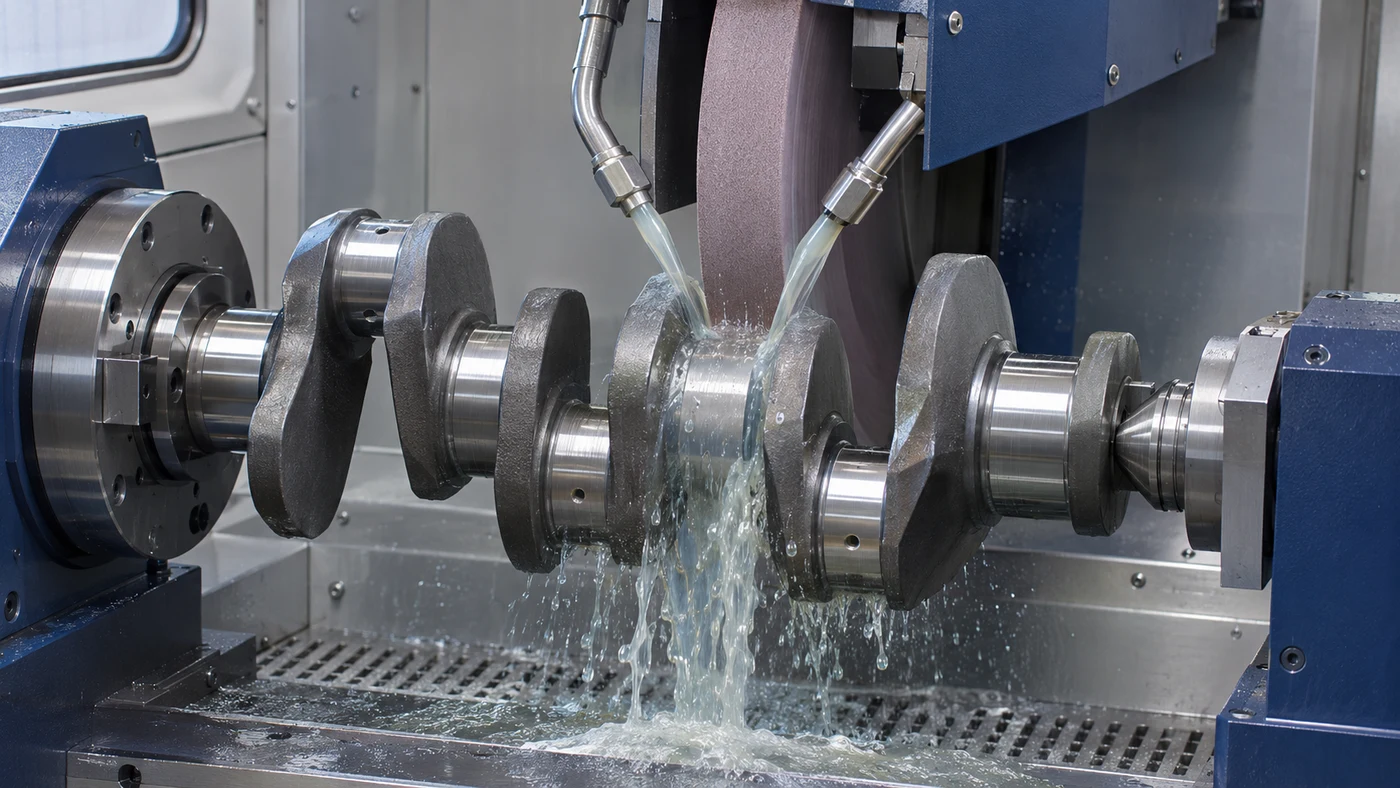
Watch: Crankshaft and Camshaft Grinding Coolants and Oils
Crankshaft and Camshaft Grinding: Different Features, Different Contacts
Crankshaft and camshaft grinding produce precision surfaces that serve different functions. A crankshaft includes concentric main journals, offset crankpins, shoulders and transitions. A camshaft combines bearing journals with shaped lobes that control motion. These features do not all present the same grinding contact. Begin with the component drawing, material condition and actual feature being ground. Production grinding and repair grinding also need their own process and acceptance plans. QA has coolant and grinding-oil options for evaluation with your machine and abrasive system. A fluid inquiry should identify whether the concern is journal size, lobe profile, wheel wear, surface finish or suspected thermal damage. Knowing the feature helps connect the fluid decision to the supported cycle and the measurements that matter.
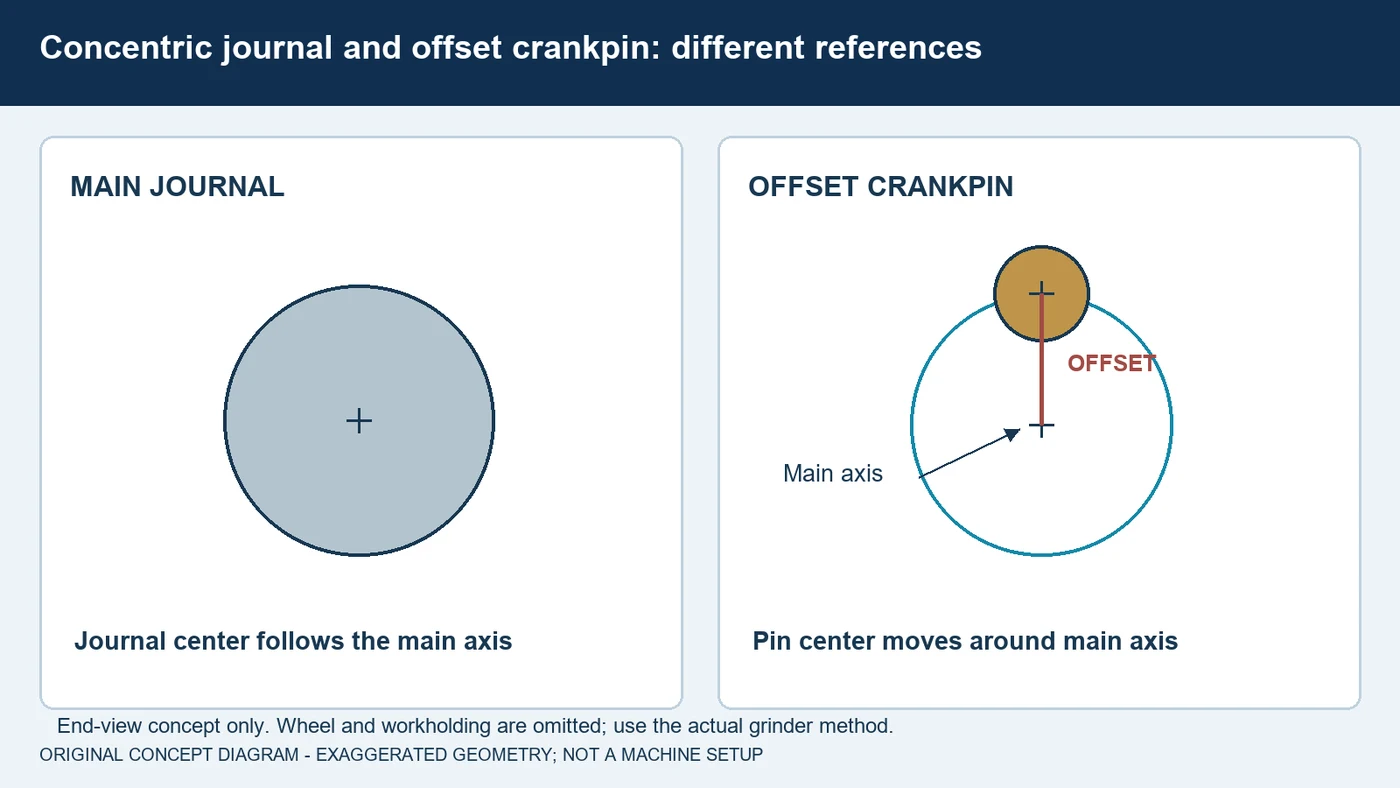
Crankshaft Pins Move Around the Main Axis
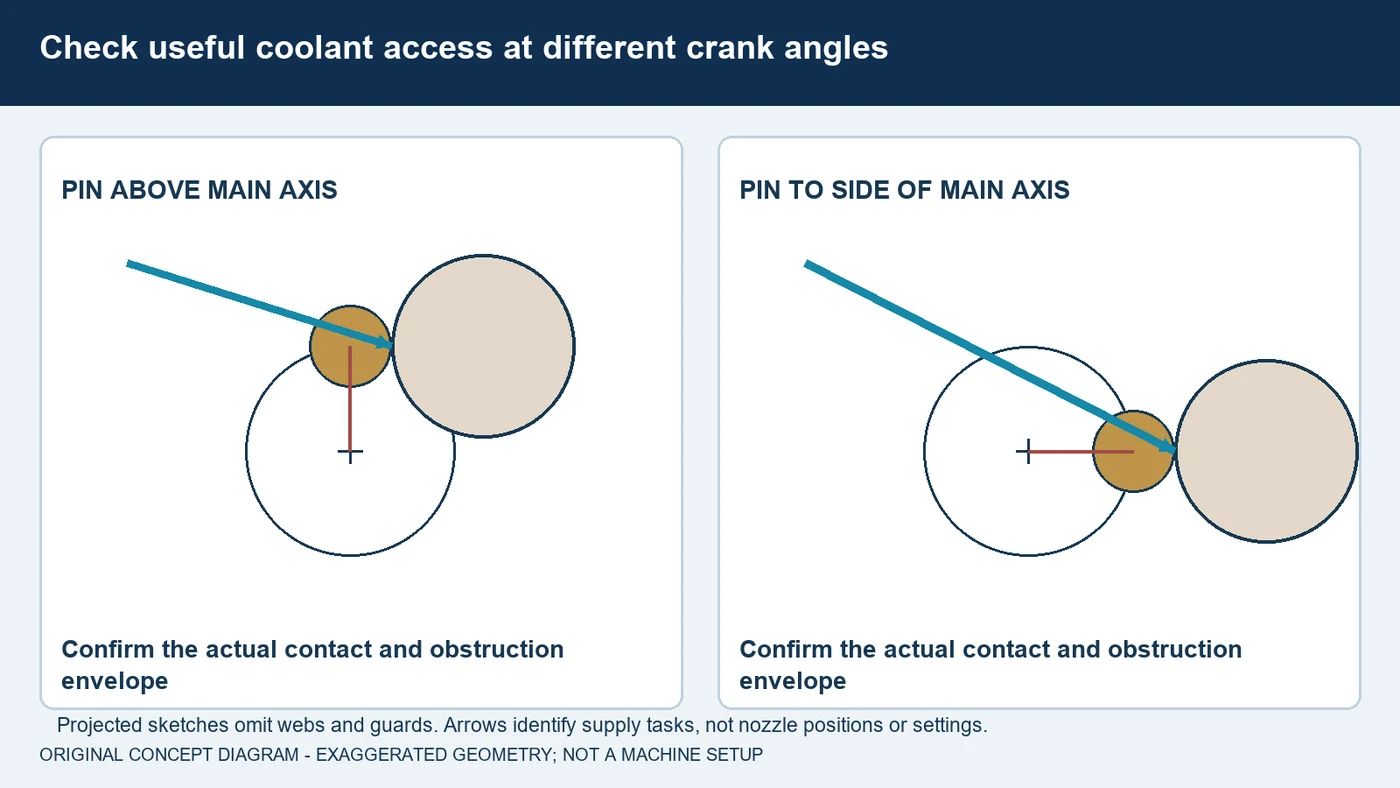
Main-journal grinding and crankpin grinding involve different geometric references. A crankpin is offset from the main rotation axis. In an orbital or pin-chasing process, the crankshaft rotates about its main axis while the grinding system follows the moving pin through coordinated machine motion. Other machines use a different supported setup, so identify the actual method before transferring an operating idea. Workholding and steady support affect the result, particularly on a long shaft. Journal diameter, axial shape and the specified shoulder or transition geometry must be produced together. A correct reading at one location does not establish the complete bearing surface. Record the support arrangement, roughing and finishing sequence, and measurement corrections along with the fluid and wheel condition.
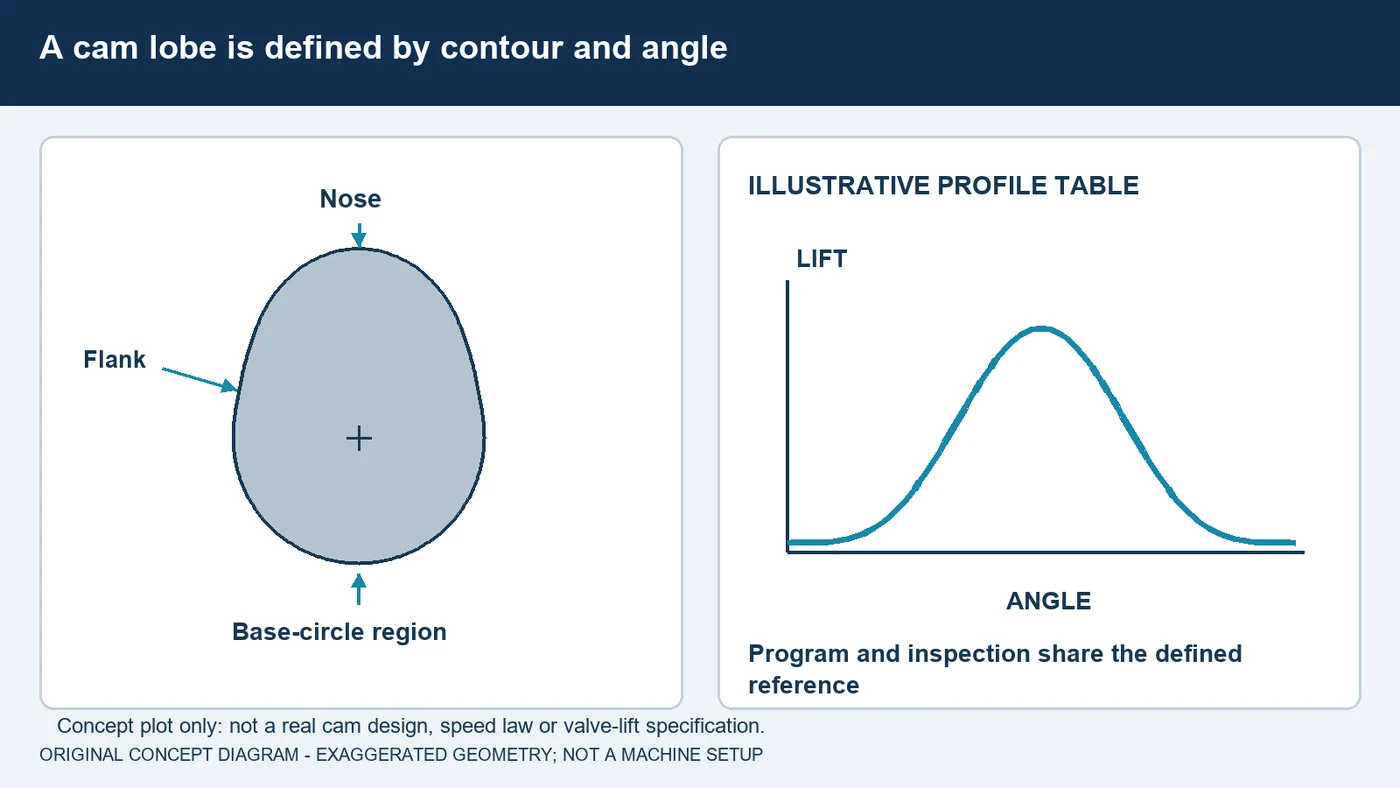
Cam Grinding Follows a Defined Lobe Profile
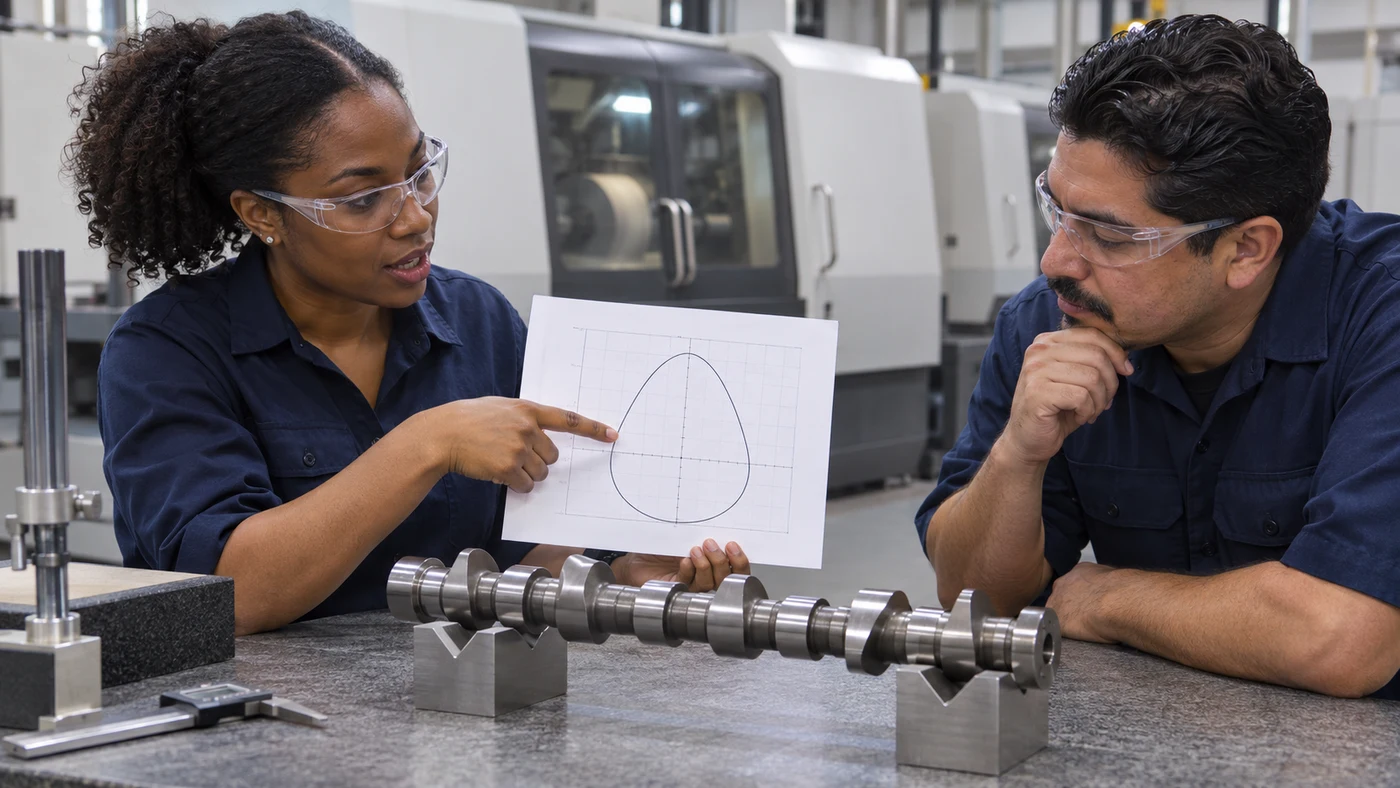
Camshaft lobe grinding follows a defined noncircular contour. In a suitable CNC process, coordinated workpiece rotation and grinding-axis motion reproduce the required geometry. The design may be supplied as a profile or lift table referenced to angle. The base-circle region, flanks and nose present changing contact conditions as the lobe rotates. Some profiles include concave regions that limit which wheel diameters can reach the contour. The machine program and abrasive arrangement must account for those features; a simple egg-shaped sketch is not a production cam definition. Keep lobe orientation and the required angular references in the setup and inspection plan. Bearing journals remain a separate cylindrical grinding task, even when the same machine produces both features.
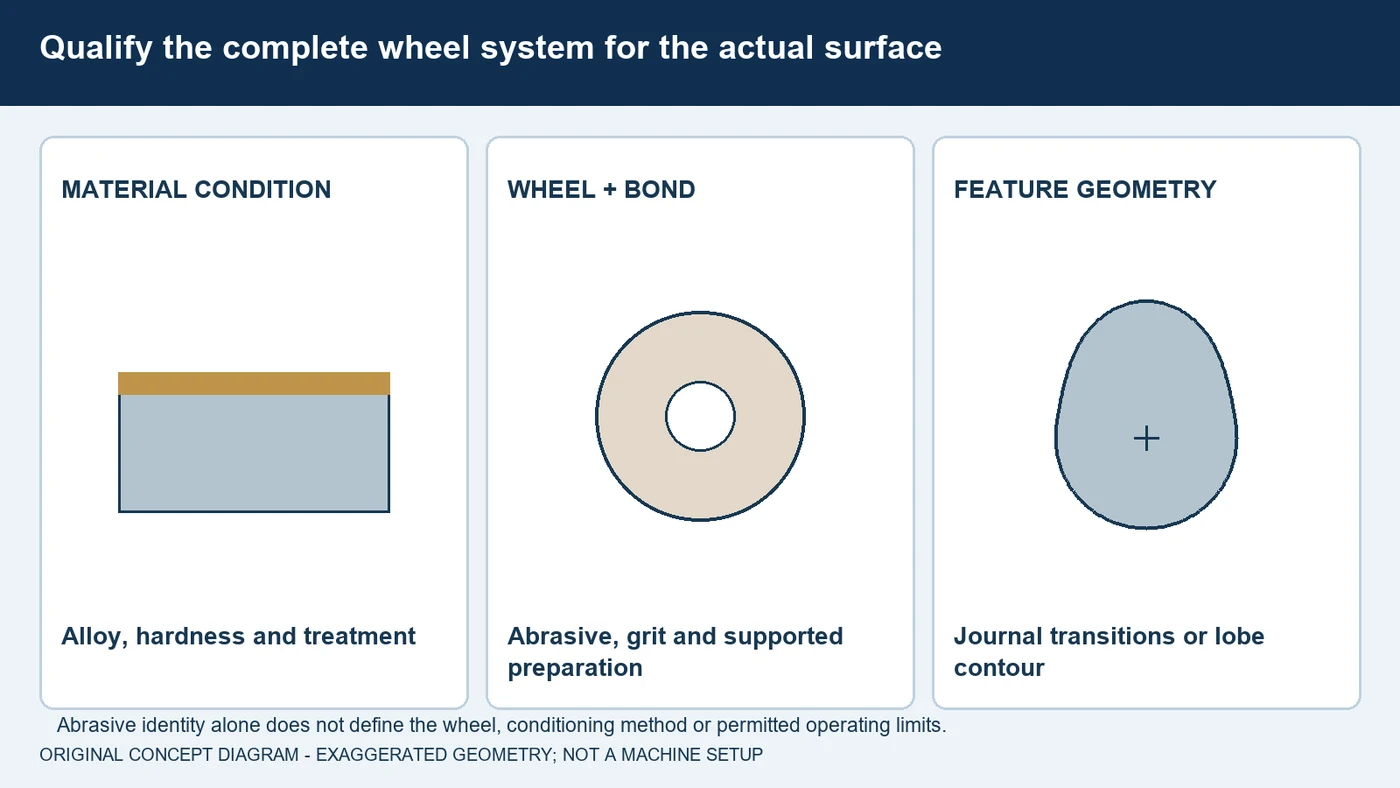
Match the Surface, Wheel and Conditioning Method
The exact steel or iron grade, hardness and surface treatment influence abrasive and fluid selection. Hardened-steel production often uses CBN systems, while conventional abrasives also serve qualified applications. Abrasive identity alone does not define a wheel specification. Bond, grit, structure, shape and supported conditioning method must suit the component and machine. Journal shoulders, specified radii and lobe contours introduce geometric requirements beyond the central contact. Track wheel wear, prepared size and compensation before comparing fluids. Do not apply a generic wheel radius or material-removal allowance to a critical transition. For repaired or recoated components, establish the actual remaining surface and permitted process with the responsible specification. A wheel grade or cutting speed proven on another installation is not automatically appropriate here.
Follow Coolant Access Through the Full Rotation
Coolant access can change continuously during crankpin and lobe grinding. The pin moves relative to the main axis, and the cam surface changes its orientation at the contact. A fixed stream that reaches one position may miss or be obstructed at another. Examine useful supply throughout the qualified cycle, including nearby counterweights, shoulders and workholding. Some equipment uses controlled nozzle tracking; the correct arrangement depends on the actual grinder. Review nozzle clearance as well as pump delivery, filtration and return capacity. Interface cooling and separate wheel-cleaning duties should be identified rather than assumed to be the same stream. A large splash does not demonstrate that the active contact receives clean fluid. Set flow, pressure and temperature with the equipment and nozzle suppliers for that process.
Evaluate Oil or Water-Mix Fluid as a Complete System
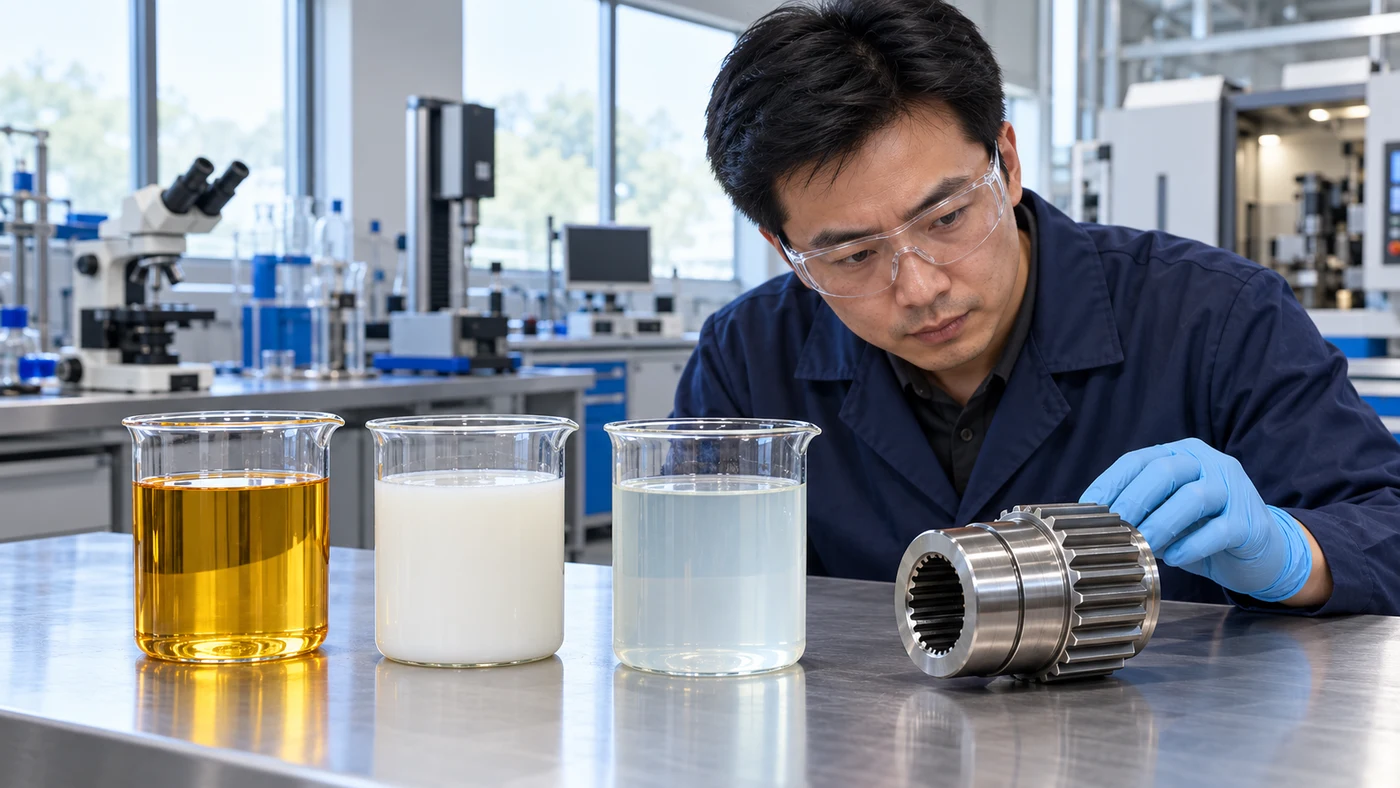
Both grinding oils and water-miscible fluids appear in qualified camshaft and crankshaft applications. The correct choice depends on the machine, wheel and process, rather than a blanket rule that all CBN grinding requires oil. Review lubrication, heat removal, foam behavior, corrosion protection, filterability and cleaning requirements for the actual formulation. A change of fluid type also requires confirmation that the machine and protective systems are suitable. For a diluted coolant, follow the recommended mixing water and working concentration, using the product-specific refractometer factor. Keep temperature and contamination records with the trial. Metal fines and loose abrasive should be removed by the specified filtration system. Clear-looking coolant alone is not proof of adequate filtration or maintained chemistry. QA has coolant and oil options to evaluate against those requirements.
Verify Geometry and Surface Integrity Separately
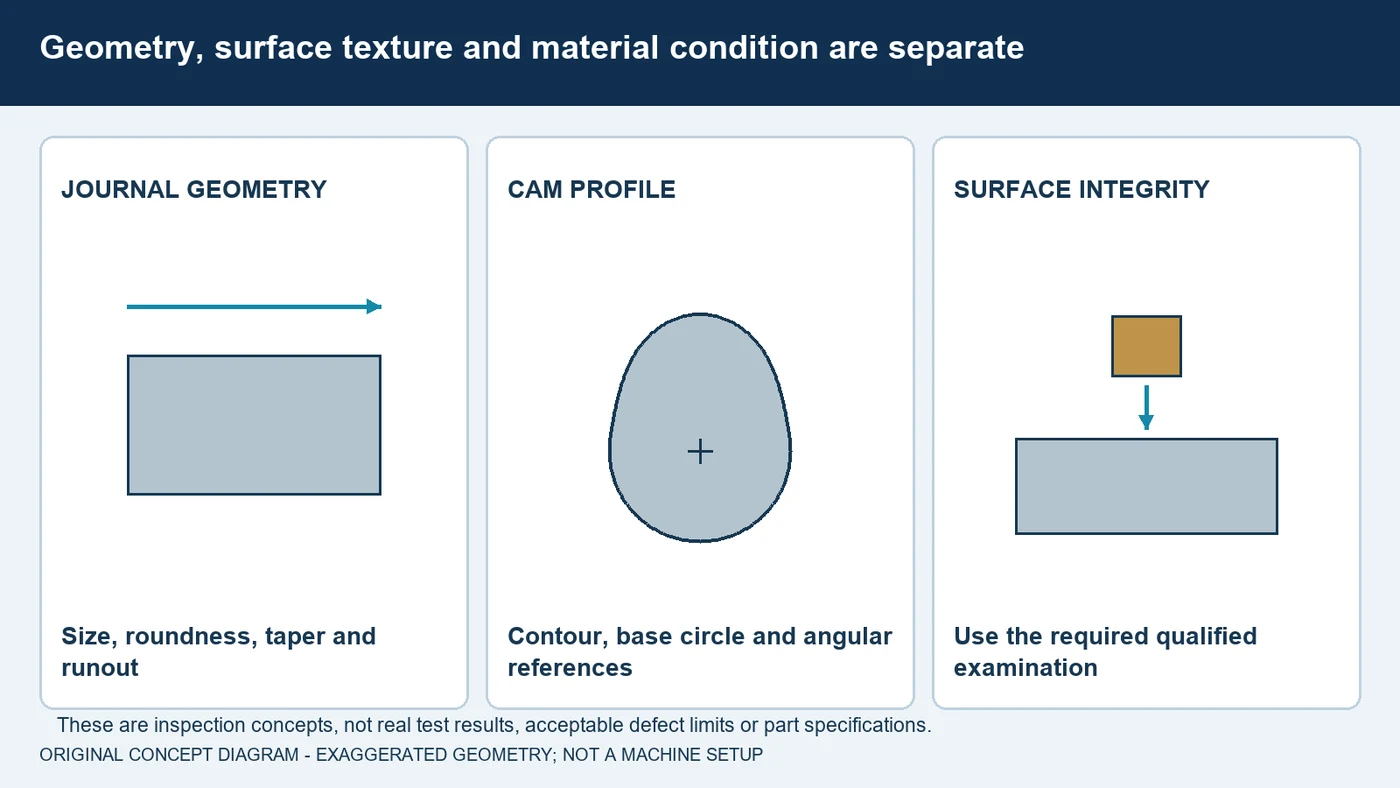
Journal inspection can include diameter, roundness, taper, runout and the specified transition geometry. Cam inspection adds the required contour, base-circle properties and angular relationships between features. Measure surface texture using the specified method and location. These measurements answer different questions; a smooth surface does not prove the lobe profile or journal geometry is correct. Grinding can also alter material condition through excessive local heating, sometimes without an obvious visual warning. Use the required qualified surface-integrity examination rather than relying only on discoloration. Review wheel condition, cycle, coolant specification and useful delivery together when investigating damage. For regrinding, confirm the permitted repair dimensions and treatment requirements before removal. Grinding and any later polishing or superfinishing are distinct steps, each with its own acceptance requirements.
Plan a Controlled Cam or Crank Grinding Trial
Send QA the component drawing and identify the feature: main journal, offset pin, shoulder or cam lobe. Include alloy, hardness, heat treatment or coating, and whether the job is production or approved repair. Describe the grinder, wheel and bond, conditioning interval, support arrangement and supported cycle. Add the current fluid, useful delivery, filtration and temperature records. For water-mix systems, include water quality and measured concentration. Share the actual problem with dimensional reports, profile comparisons or qualified inspection results. QA has coolant and oil options for evaluation. Agree on consistent trial conditions and compare accepted geometry, surface integrity, wheel behavior and fluid maintenance together. Confirm the final formulation and process with the equipment, abrasive and component requirements before making the production change.
Fluid selection by material
Use these as evaluation questions, not blanket product approvals.
| Material | What to evaluate | What to confirm |
|---|---|---|
| Hardened steel crankshafts and camshafts | Identify the alloy, hardness, treatment and actual journal or lobe feature. | Qualified abrasive and bond, useful delivery, geometric acceptance and surface-integrity examination. |
| Cast-iron camshafts and crankshafts | Confirm the exact iron grade, surface condition and stock allowance. | Material-specific abrasive choice, formulation compatibility, corrosion control and filtration. |
| Surface-treated, coated or approved repair parts | Establish the actual surface and permitted removal before selecting a process. | Responsible repair specification, remaining treatment or coating, dimensional limits and required verification. |
| Assembled camshafts and individual cam pieces | Include component materials and the angular and axial reference arrangement. | Workholding, profile definition, fluid compatibility and full-feature inspection. |
Questions about crankshaft and camshaft grinding fluids
What is crankshaft pin chasing?
In a suitable orbital process the shaft rotates about its main axis while coordinated grinding motion follows the offset crankpin. Other grinders may use different setups; use the actual machine method.
Is a cam lobe ground like a round journal?
No. The lobe has a defined noncircular profile and angular reference. A capable process must reproduce that contour; the bearing journals are a separate cylindrical task.
Does all CBN camshaft grinding require straight oil?
No blanket rule applies. Qualified oil and water-miscible systems exist. Confirm the actual machine, wheel bond, workpiece and formulation together.
Why should coolant delivery be checked around the full rotation?
Crankpin position, lobe contour and nearby obstructions change access. A stream that works at one position may not supply another position adequately.
Does a good surface finish prove there is no grinding burn?
No. Texture and appearance do not establish material condition. Follow the required qualified examination for suspected thermal damage.
Which QA fluid should I choose for crankshaft or camshaft grinding?
QA has coolant and oil options. Provide the feature, material condition, machine, wheel, delivery, maintenance records and acceptance requirements for evaluation.
Discuss your application with QA
QA Lubricants has coolant and oil options. Send us the operation, alloy, hardness, tooling, current fluid and the problem you want to solve.
Discuss My ApplicationShop Water Diluted CoolantsShop Straight Cutting OilsTechnical references
- JUNKER: crankshaft journals, pin chasing and coolant tracking
- JUNKER: cam geometry, interpolation and grinding-wheel access
- Fives: orbital grinding for crankshaft pins and camshaft lobes
- Norton: vitrified CBN application to camshafts and crankshafts
- Noritake: automotive pin-grinding contact and coolant changes
- Cool-Grind: automotive coolant delivery and camshaft application
- JUNKER: cam grinding with oil and optional emulsion systems
- Blaser Swisslube: product-specific coolant concentration measurement
- Norton: wheel conditioning, filtration and surface finish
- MARPOSS: dimensional, geometric and nondestructive shaft inspection
- Mahr: cam profile, angle and journal measurement
- UNITED GRINDING: grinding burn and detection
Original educational content and illustrations. Confirm current machine, tool and fluid instructions. Trademarks belong to their respective owners.