
Deep-Hole & Gun Drilling Oils and Coolants
Explore gun-drilling oil, deep-hole drilling coolant, BTA flow paths, tool support, filtration and chip evacuation with QA Lubricants.

Watch: Deep-Hole & Gun Drilling Oils and Coolants
Deep Holes Need a Complete Fluid System
What makes gun-drilling oil or deep-hole drilling coolant different from a general machining-fluid discussion? The cutting point works inside a long passage, and the process depends on getting fluid in and chips out consistently. Hole diameter, depth, straightness and finish all belong in that discussion, along with the machine and tooling. A long hole is not simply an ordinary drilling cycle extended farther into the part. In this QA Lubricants guide, we explain the main fluid paths, tool support and practical selection questions behind deep-hole drilling. We distinguish single-flute gun drilling, BTA drilling and ejector systems without treating them as interchangeable. QA has coolant and oil options. Our original illustrations explain concepts; they do not replace the instructions for a particular machine or tool.
Gundrilling, BTA & Ejector Flow Paths
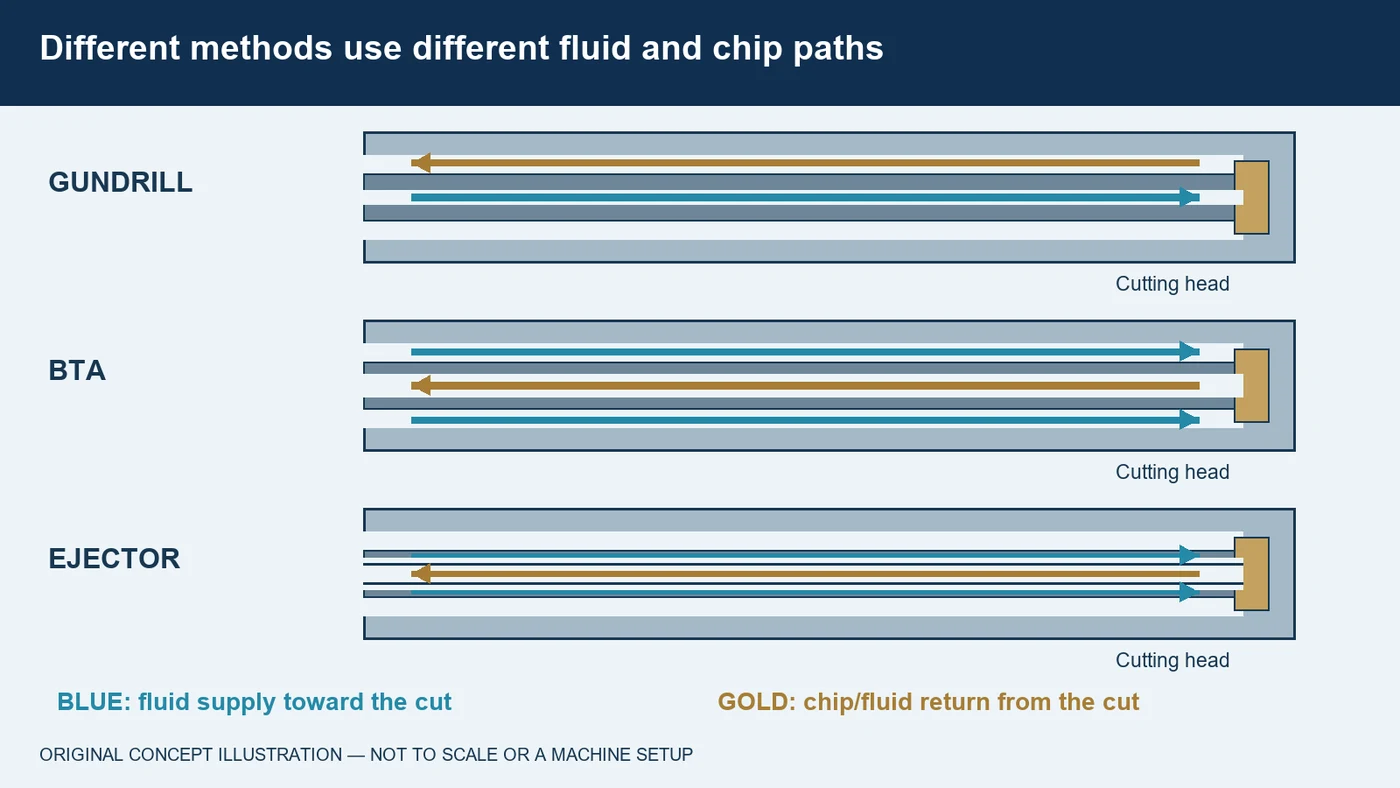
In single-flute gun drilling, coolant passes through a channel inside the tool to the cutting head. The fluid and chips return along the V-shaped groove on the outside of the tool. In BTA drilling, the arrangement is different: fluid is supplied through the space around the drill tube, while chips and returning fluid pass through the tool's interior. An ejector system uses inner and outer tubes, with supply between them and chip return through the inner tube. These paths determine more than the names of the tools. They affect the required connections, chip handling and machine configuration. Do not interpret outside supply in BTA as an ordinary nozzle spraying at the hole entrance. Identify the complete system before discussing fluid, pump capacity or a conversion from another drilling method.
Guidance & Tool Support Come First
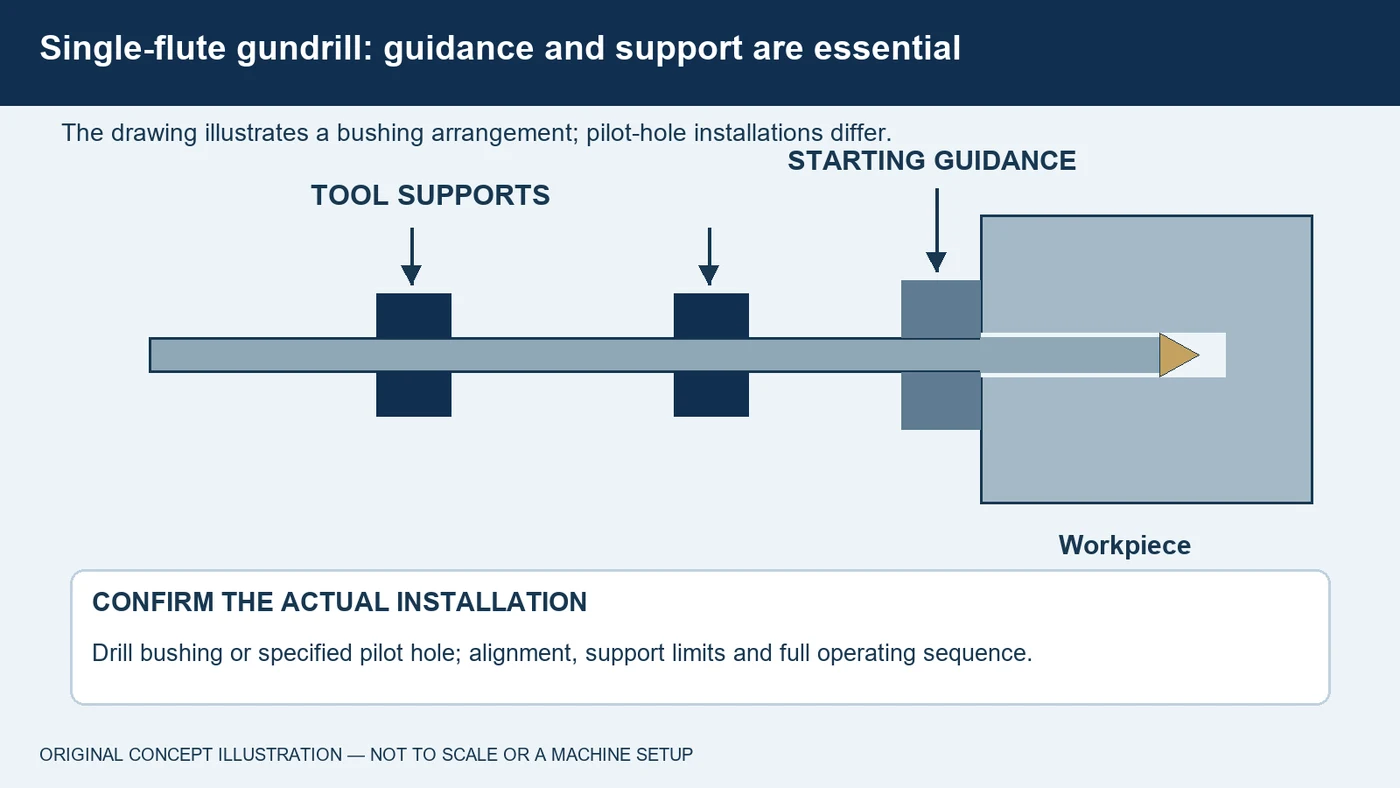
A long, slender drilling tool needs the guidance and support specified by its manufacturer. Single-flute gundrills are not ordinary self-centering twist drills. Depending on the installation, the starting guidance may be a drill bushing or a correctly prepared pilot hole. The quality and alignment of that guidance matter. Additional supports and limits on unsupported length also depend on the tool and machine. Never spin an unsupported long gundrill as though it were a short jobber drill. Follow the complete manufacturer's approach, entry, coolant and spindle sequence, and withdrawal instructions. Those details are not universal, and this guide does not supply a substitute cycle. Also review how the tool or workpiece rotates in the actual process. A new oil cannot correct an unsuitable pilot hole, poor alignment, inadequate support or the wrong operating sequence.
Flow, Pressure, Filtration & Temperature
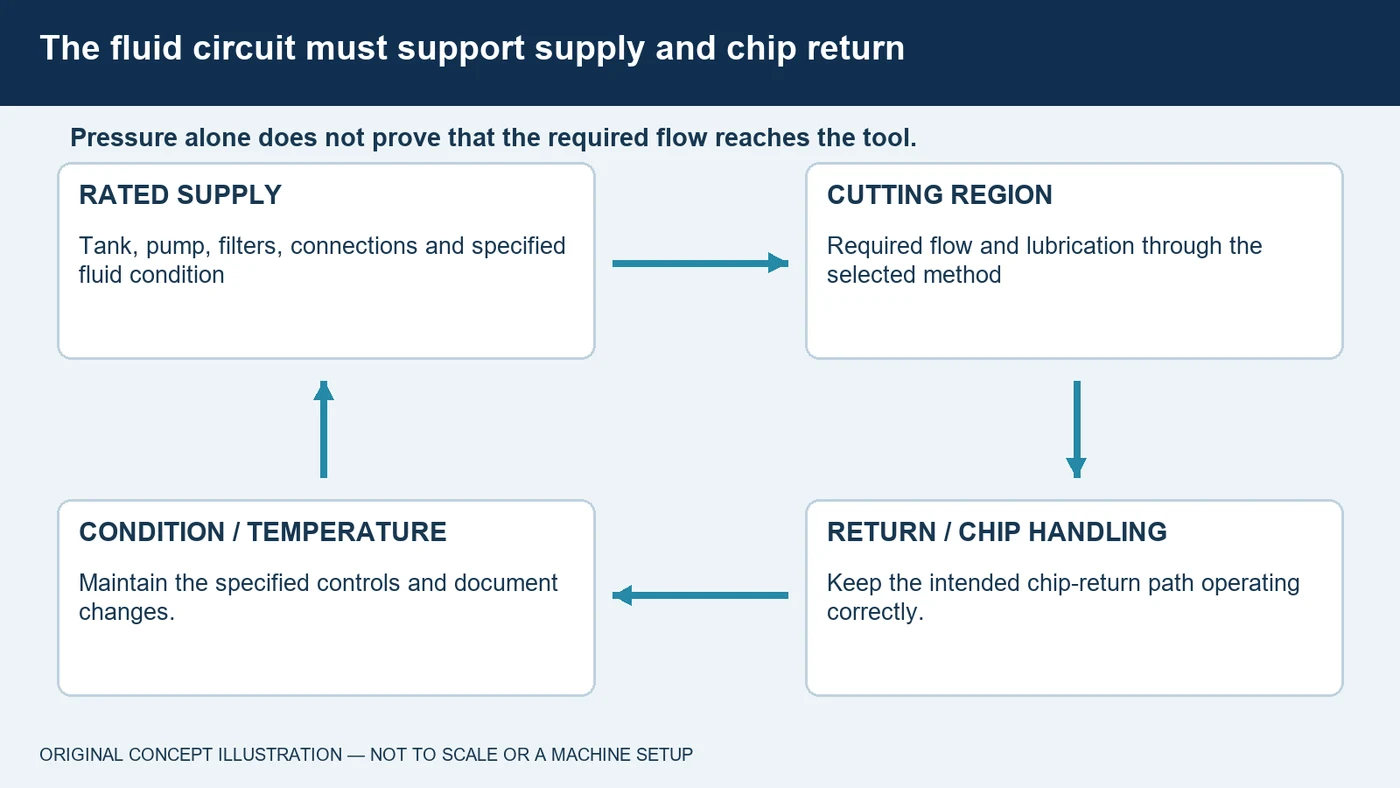
A deep-hole drilling circuit is a system, not just a high-pressure pump. The fluid has to reach the working end and carry chips back through the intended return path. A pressure reading alone does not establish that the required flow reaches the tool. Restrictions, connections, filters and the fluid itself influence delivery. Use the machine and tool requirements for the actual diameter and process; do not borrow a pressure or flow value from a different installation. Filtration must suit the tooling and contamination load, and the return system must handle the chips being produced. Review the specified temperature control as well, particularly when investigating dimensional consistency or changes during a production run. Keep all pumps, hoses, seals, connections and protective systems within their ratings. Inspect or service the circuit only through the approved machine procedure.
Oil or Emulsion: Confirm the Application
Dedicated deep-hole drilling oils are one fluid option. Suitable water-miscible formulations are also used in some systems, but that does not make any ordinary diluted coolant a direct replacement. Confirm the tool and machine approval, application requirements and actual product guidance before changing families. For a straight oil, evaluate viscosity together with lubrication, additive chemistry, flow and machine compatibility. Do not thin an oil with an unapproved solvent. For a water-miscible product, use its specified application concentration and measurement method. Aluminum, stainless steel, alloy steel, titanium and nickel alloys present different selection questions. Copper-containing alloys require attention to nonstaining chemistry and active-sulfur compatibility. Include all materials in a shared sump, plus cleaning and residue requirements. A family label or one viscosity number does not establish that a formulation is suitable for a demanding deep hole.

Use Chips, Tool Wear & Hole Quality as Evidence
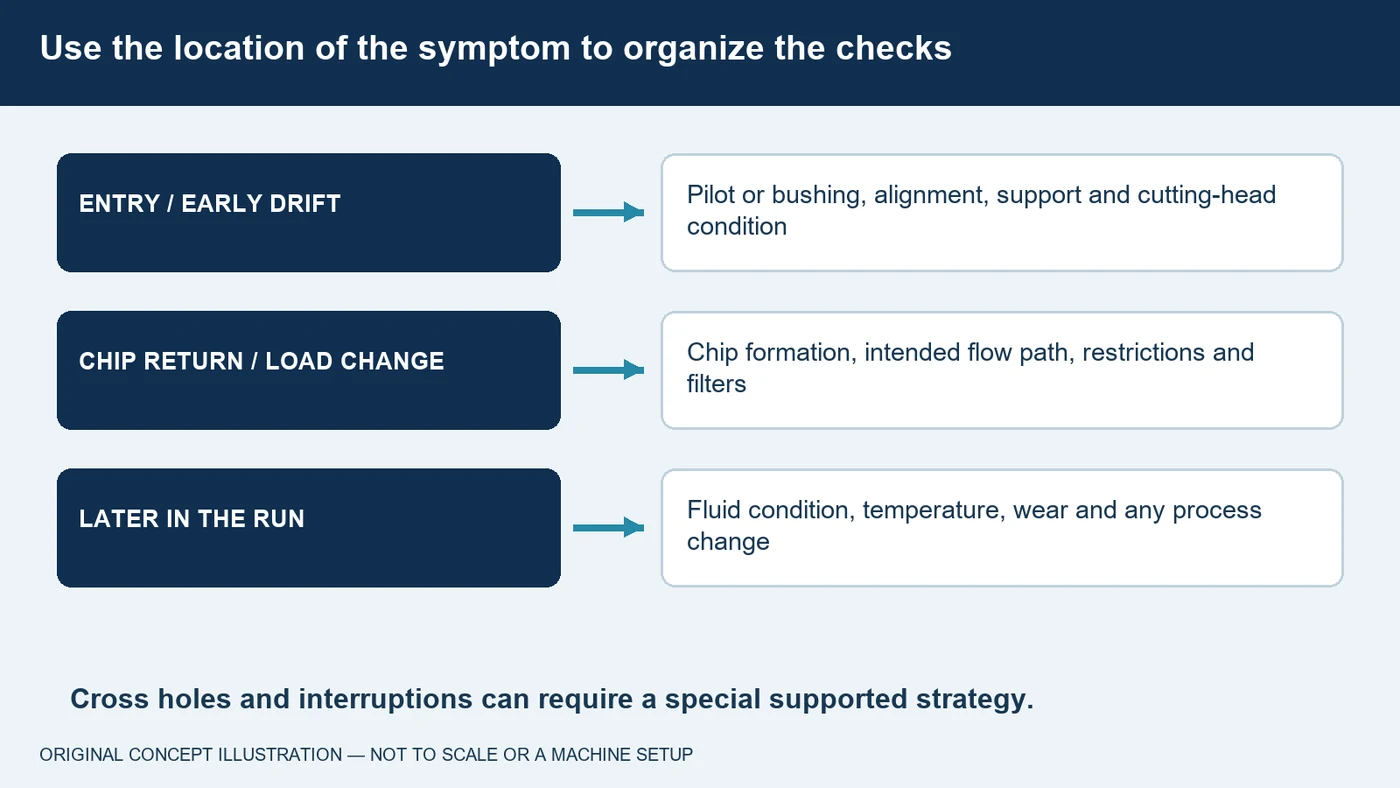
When a deep-hole operation becomes unreliable, note where the problem appears. Is it at entry, at a particular depth, after an interruption or only late in a production run? Keep evidence of chip condition, tool wear and hole measurements. Chip packing and poor return deserve a different investigation from drift, poor starting guidance or a damaged cutting edge. Review the tool maker's chip-forming and cutting-condition guidance rather than treating every problem as insufficient pressure. Cross holes, angled surfaces and interrupted cuts can also require a special strategy. Establish a stable baseline before a fluid trial and document any tool or program change. Compare hole size, straightness, finish, tool life and chip evacuation under comparable conditions. Stop safely if the process becomes abnormal; repeating a failing cycle is not a useful trial. A successful recommendation needs repeatable acceptable parts, not one good bore.
Keep Fluid Condition Consistent
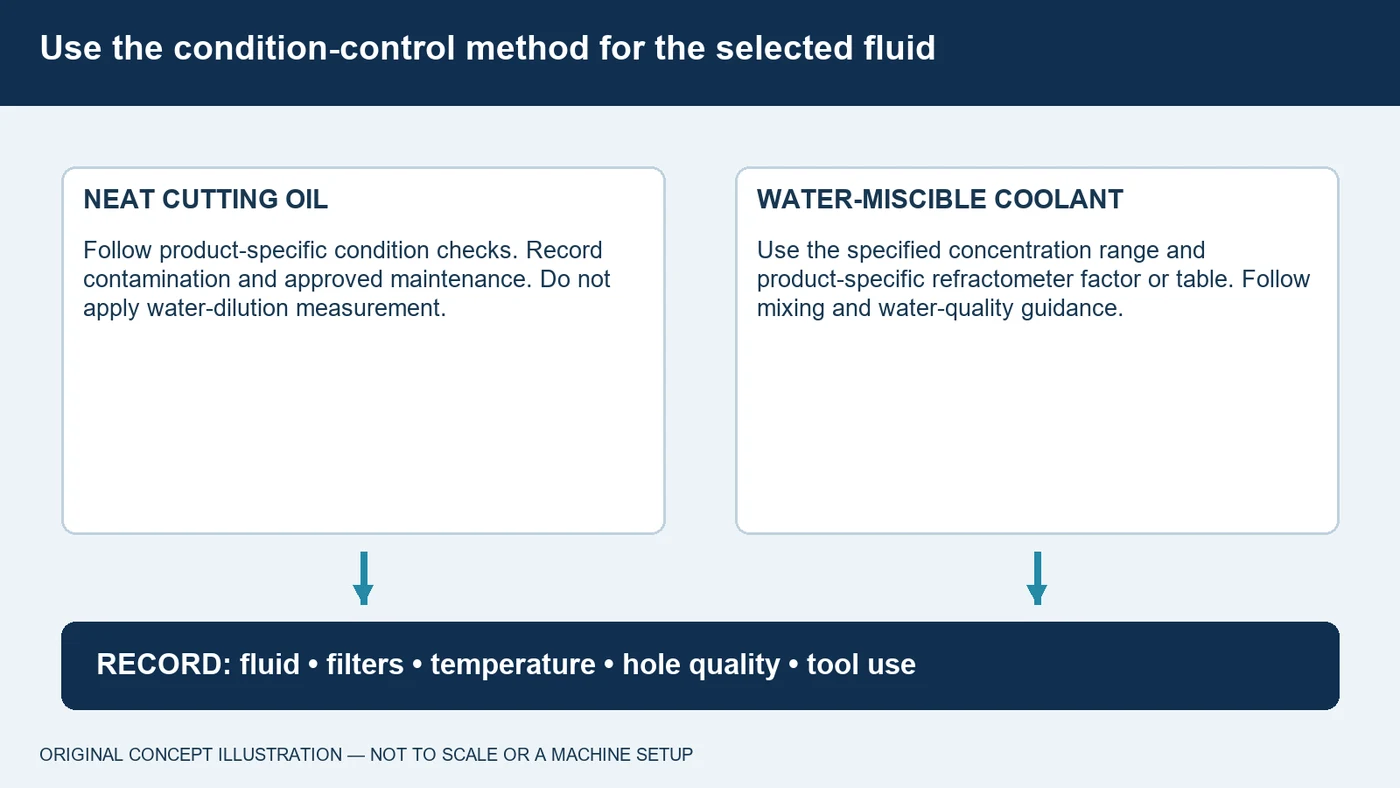
The fluid that reaches the next hole should remain within the agreed condition limits. Record tank level, contamination, filter condition and the checks required for the selected fluid. With a water-miscible coolant, apply the correct product-specific refractometer factor or concentration table. The number on the instrument is not automatically the actual mixture percentage. Neat cutting oil uses a different condition-control method. Follow the supplier's guidance for either system and avoid unapproved additives or mixtures. When changing products, plan the cleaning and changeover procedure so unknown residues do not confuse the results. Track temperature and supply observations alongside hole quality and tool use. These records help distinguish an application mismatch from a maintenance change. Maintain the required enclosure, extraction and protective equipment for the installation. A product's flash point is not a guarantee that a cutting-oil process cannot ignite.
Build Your Deep-Hole Fluid Recommendation
To discuss a gun-drilling oil or deep-hole drilling coolant with QA Lubricants, send the hole diameter, depth and drawing requirements. Identify whether the process uses a single-flute gundrill, BTA, ejector or another supported method. Include the machine and tool, material and hardness, guidance arrangement, current fluid, filtration and temperature control. Explain the problem you want to improve: evacuation, finish, straightness, hole size, tool life or fluid condition. Add any customer restrictions on the process, residues or additives. QA has coolant and cutting-oil options and can help evaluate candidates against the actual machine and tooling requirements. Confirm application guidance and acceptance criteria before a controlled shop trial. Visit QA Lube dot com for more metalworking guides, or call one, eight seven seven, eight seven seven, six two two one. Thank you for watching.

Fluid selection by material
Use these as evaluation questions, not blanket product approvals.
| Material | What to evaluate | What to confirm |
|---|---|---|
| Carbon and alloy steels | Evaluate chip formation, lubricity and protection of the drilled surface. | Exact grade, hardness, heat treatment, drill geometry and the complete hole drawing. |
| Stainless steels | Evaluate evacuation and lubrication with the specified cutting strategy. | Alloy condition, work-hardening concerns, tool design and stable supply at depth. |
| Aluminum alloys | Evaluate adhesion control, nonstaining compatibility and chip transport. | Alloy, hole finish, cleaning requirements and compatibility with the shared fluid system. |
| Brass, bronze and copper alloys | Evaluate nonstaining additive chemistry and the alloy's chip behavior. | Active-sulfur compatibility, residues and downstream treatment requirements. |
| Titanium and nickel alloys | Evaluate a specialist fluid and tool/system combination in a controlled trial. | Material condition, customer process restrictions and supplier application guidance. |
| Mixed-material or shared systems | Evaluate every material and process using the same fluid. | Machine compatibility, filtration, temperature control and changeover requirements. |
Questions about deep-hole drilling fluids
Is gun drilling the same as BTA drilling?
No. In single-flute gundrilling, fluid travels through the tool and returns with chips along the outside flute. In BTA drilling, fluid enters around the drill tube and the chips return through its interior. Ejector systems use a separate two-tube arrangement.
Does every deep-hole operation require straight cutting oil?
No. Deep-hole drilling oils and suitable water-miscible formulations are both used, depending on the tool, machine and application. Confirm the exact system before selecting a fluid or changing fluid families.
What coolant pressure or filtration size should I use?
Use the requirements for the actual drill, diameter, machine and fluid. Pressure, flow and filtration are related system choices; a general educational guide cannot supply one setting for all deep-hole processes.
Can I run a long gundrill like an ordinary twist drill?
Do not assume that. Follow the tool maker's pilot-hole or drill-bushing requirements, support limits and complete start/stop sequence. Unsupported rotation can be hazardous, and a fluid change does not replace the required guidance.
What information does QA need for a gun-drilling oil recommendation?
Provide the hole diameter and depth, process type, machine, tool, alloy and hardness, current fluid, delivery and filtration details, and the quality or tool-life problem. QA has coolant and oil options for application review.
Discuss your application with QA
Read this guide in the QA online store
QA Lubricants has coolant and oil options. Send us the operation, alloy, hardness, tooling, current fluid and the problem you want to solve.
Discuss My ApplicationShop Water Diluted CoolantsShop Straight Cutting OilsTechnical references
- UNISIG: deep-hole drilling methods, coolant flow and process parameters
- botek: single-flute gundrilling coolant and chip-return paths
- botek: BTA single-tube system and pressure-head arrangement
- botek: ejector double-tube system
- botek: deep-hole drilling systems and application requirements
- botek: guidance and support for single-flute gundrills (Type 110 technical guide)
- QualiChem: straight oils including dedicated deep-hole drilling formulations
- Sandvik Coromant: drilling challenges in different materials
- Blaser Swisslube: product-specific concentration measurement
Original educational content and illustrations. Confirm current machine, tool and fluid instructions. Trademarks belong to their respective owners.