
Form & Roll Tapping Lubricants and Coolants
Understand form-tapping lubrication, material ductility, prepared-hole size, tool grooves, torque and formed-thread inspection with QA Lubricants.
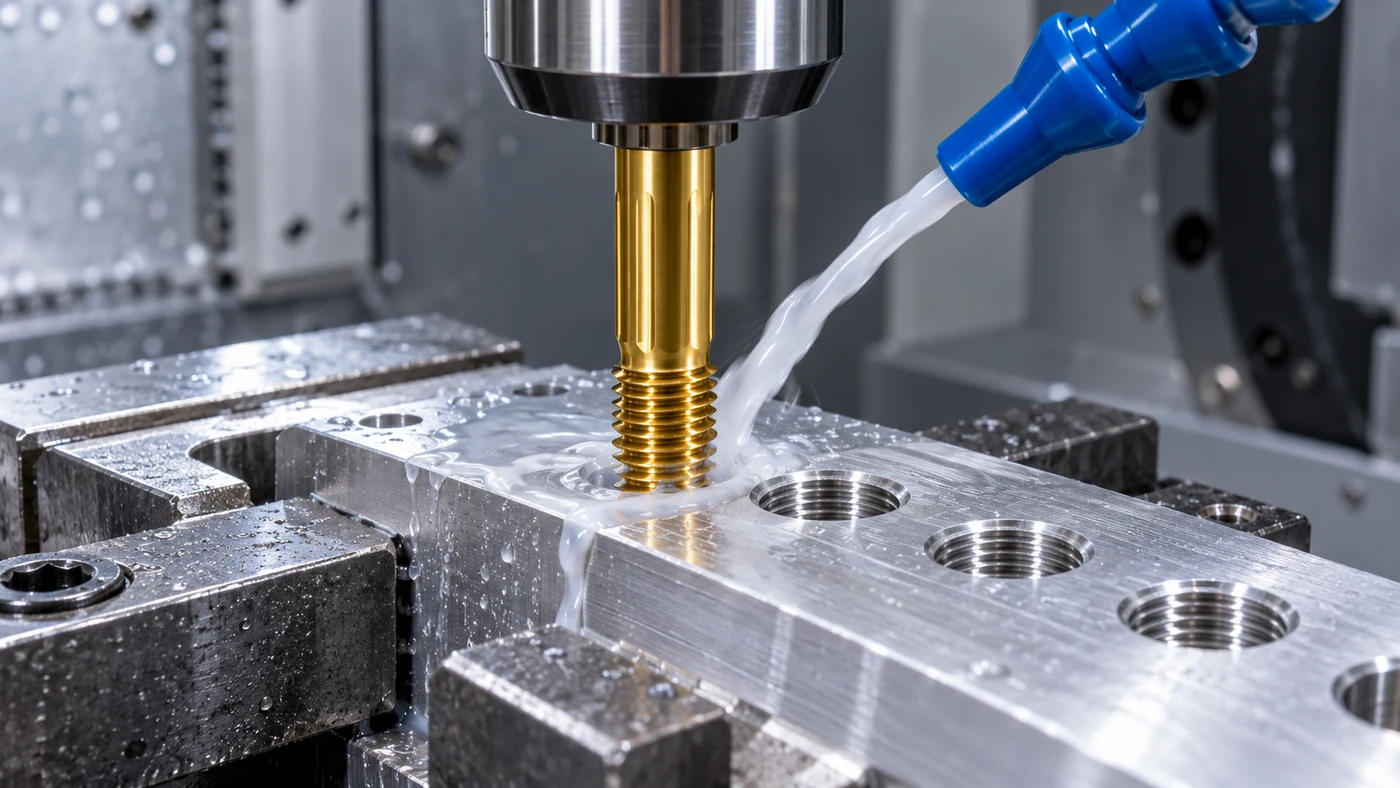
Watch: Form & Roll Tapping Lubricants and Coolants
Form Tapping Moves Metal Instead of Cutting It
What changes when an internal thread is formed instead of cut? A form tap, also called a roll tap, uses its forming profile to displace suitable material into the thread shape. The operation does not generate cutting chips like a conventional cutting tap. But chipless does not mean that preparation, lubrication or inspection can be skipped. The drilled hole, material condition and contact between the tool and workpiece still control the result. In this QA Lubricants guide, we explain form-tapping lubricants, prepared-hole requirements and the checks behind a useful application review. QA has coolant and oil options for metalworking. We will evaluate the actual process rather than promise that one fluid suits every forming tap. Our original images and diagrams illustrate principles, not a universal machine setup or a guaranteed production result.
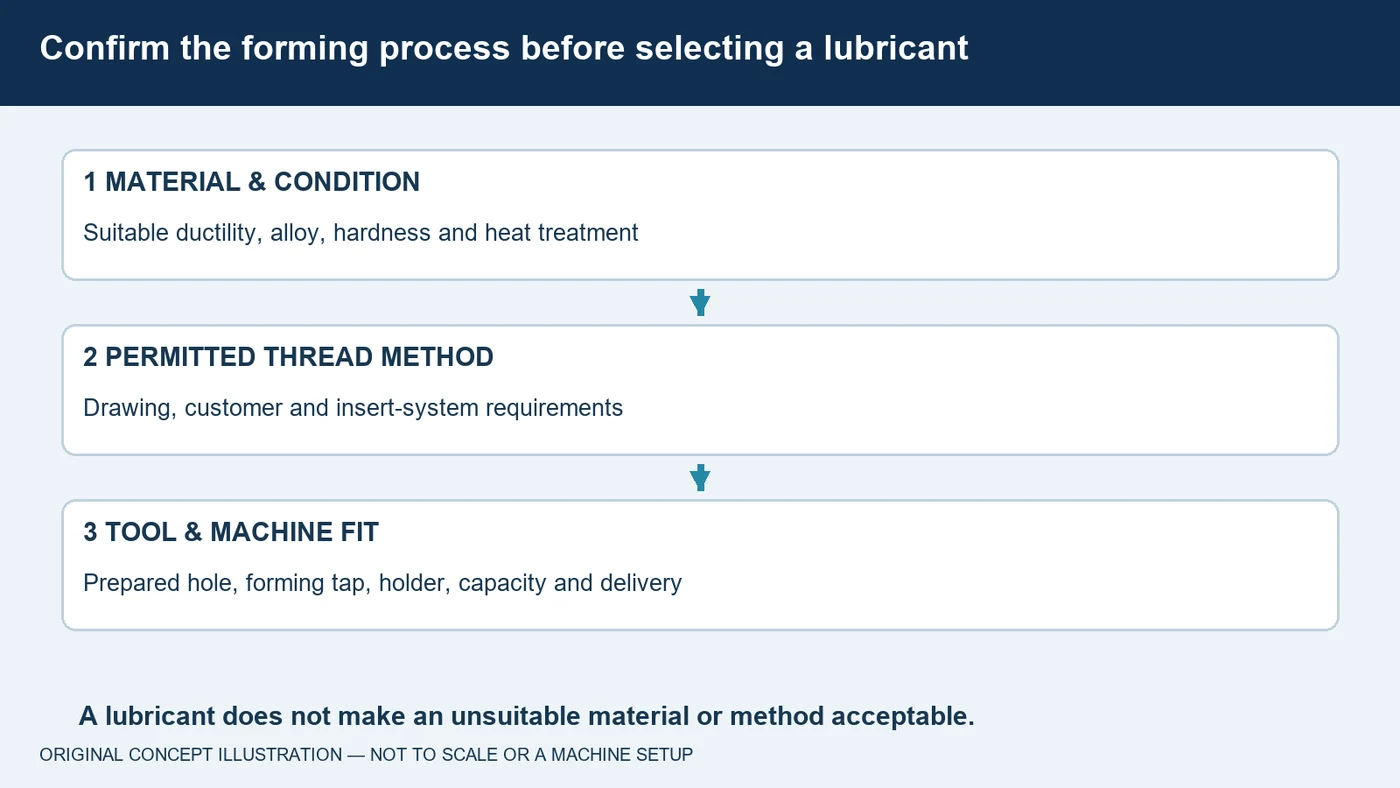
Confirm Formability & Process Permission
Form tapping depends on plastic deformation, so the material must be capable of the required flow. Some aluminum alloys, low-carbon steels, austenitic stainless steels and ductile copper alloys are candidates, but that is not approval for every grade or condition in those families. Hardness, heat treatment and casting composition can change the discussion. Do not try to make a brittle or otherwise unsuitable material formable by changing the lubricant alone. Also check that the drawing and customer process permit a formed thread. Insert-thread applications deserve particular attention. KATO's published guidance generally discourages forming taps for its screw-thread-insert holes because the minor diameter and crest profile can affect installation. That is a system-specific caution to confirm with the responsible supplier and quality team, not a reason to assume every ordinary thread has the same restriction.
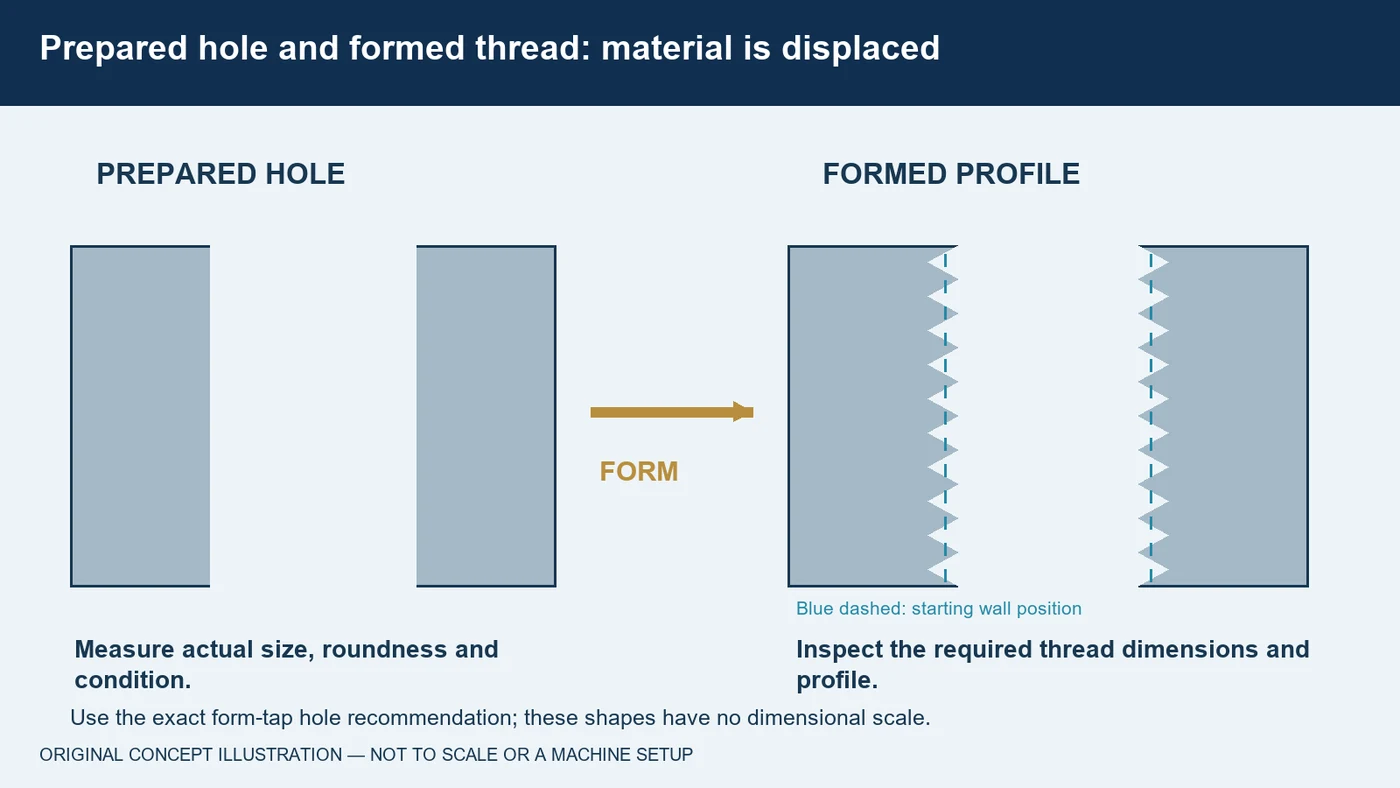
Use the Form-Tap Hole Recommendation
For the same nominal thread, a forming tap generally uses a larger prepared hole than a cutting tap because the material flows during forming instead of being removed. Use the recommendation and tolerance for the actual tool, thread and material. A nominal drill marking does not prove the finished hole is correct. Measure the hole and review size variation, roundness and surface condition through its depth. An undersized hole can increase the forming load, while an oversized hole can leave inadequate thread formation. Do not solve either problem by adjusting the hole beyond the permitted limits. In a blind hole, also allow for the forming lead, tool end and drilled-bottom geometry. Required full-thread depth and total drilled depth are different. A chipless process still needs the specified clearance and a supported operating cycle.
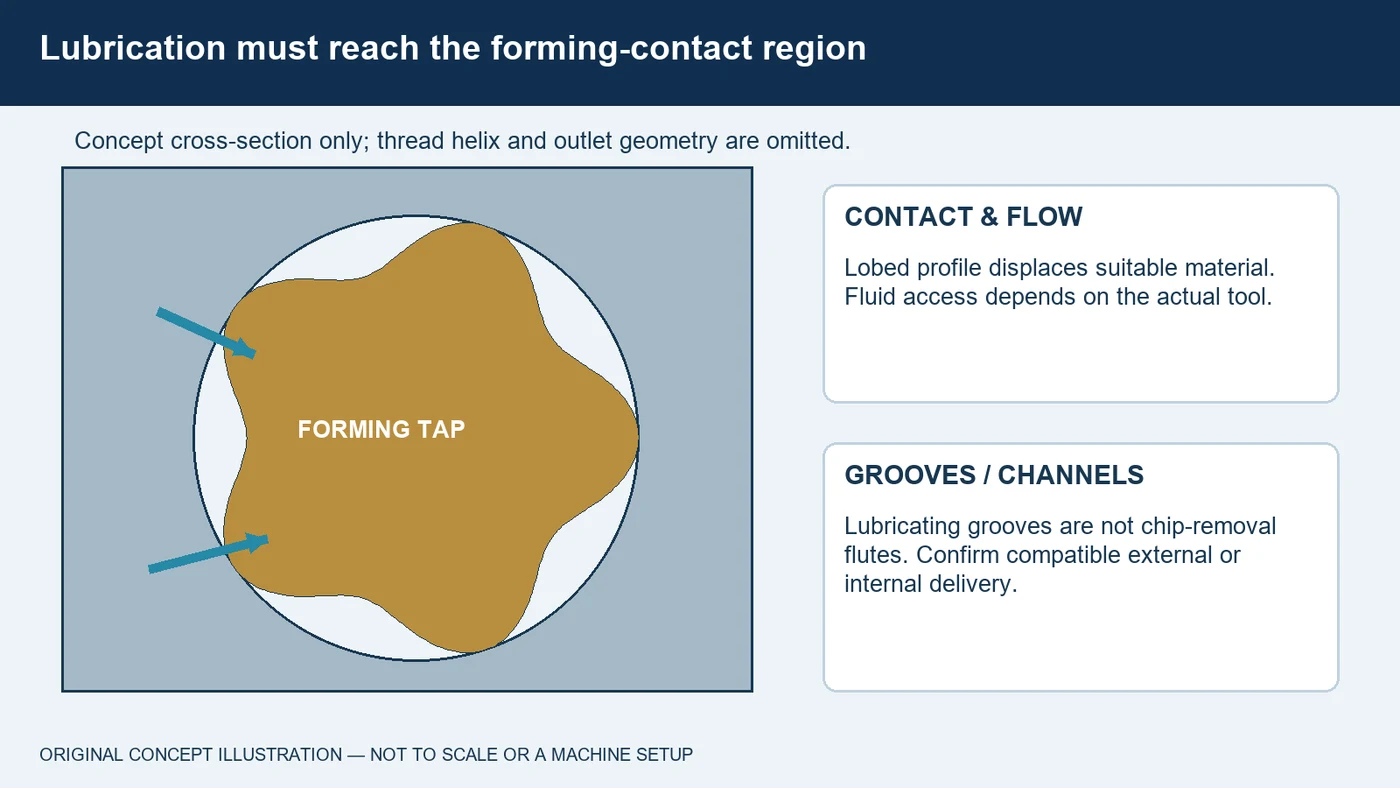
Deliver Lubrication to the Forming Contact
Lubrication is central to thread forming because the tool and material contact each other under the forming load. Confirm that the selected fluid reaches the intended working region throughout the supported cycle. Depending on the tool, delivery may use external supply, internal channels or lubricating grooves. A narrow oil groove should not be confused with the deep chip-removal flute of a cutting tap. An ungrooved tool can also have its own approved application range, so inspect the exact design rather than assume every form tap has the same features. The machine, holder and tool must support the proposed delivery method and fluid. Minimum quantity lubrication requires a compatible engineered system; simply reducing a flood stream is not the same method. Keep connections and supply within their ratings and inspect them through the machine's approved procedure.
Match the Fluid to the Material & Machine
A suitable forming lubricant may be a straight oil or a water-miscible product where the machine, tool and application permit it. The useful question is whether the actual formulation provides the required performance in that process. Do not rank every soluble oil, semi-synthetic, synthetic or vegetable-derived formulation from its family label alone. Evaluate lubrication, delivery, machine compatibility and the finished part together. Aluminum and copper-containing materials require attention to staining and additive compatibility, including active-sulfur restrictions where applicable. Stainless and other demanding materials need the exact grade and condition reviewed with the tool supplier. Include downstream cleaning, residues and every material sharing the sump. For a water-miscible fluid, follow its specified application concentration and measurement method. Do not add an unknown tapping compound or change the mixture by guesswork to compensate for an unsuitable hole or tool.

Check Forming Load, Alignment & the Cycle
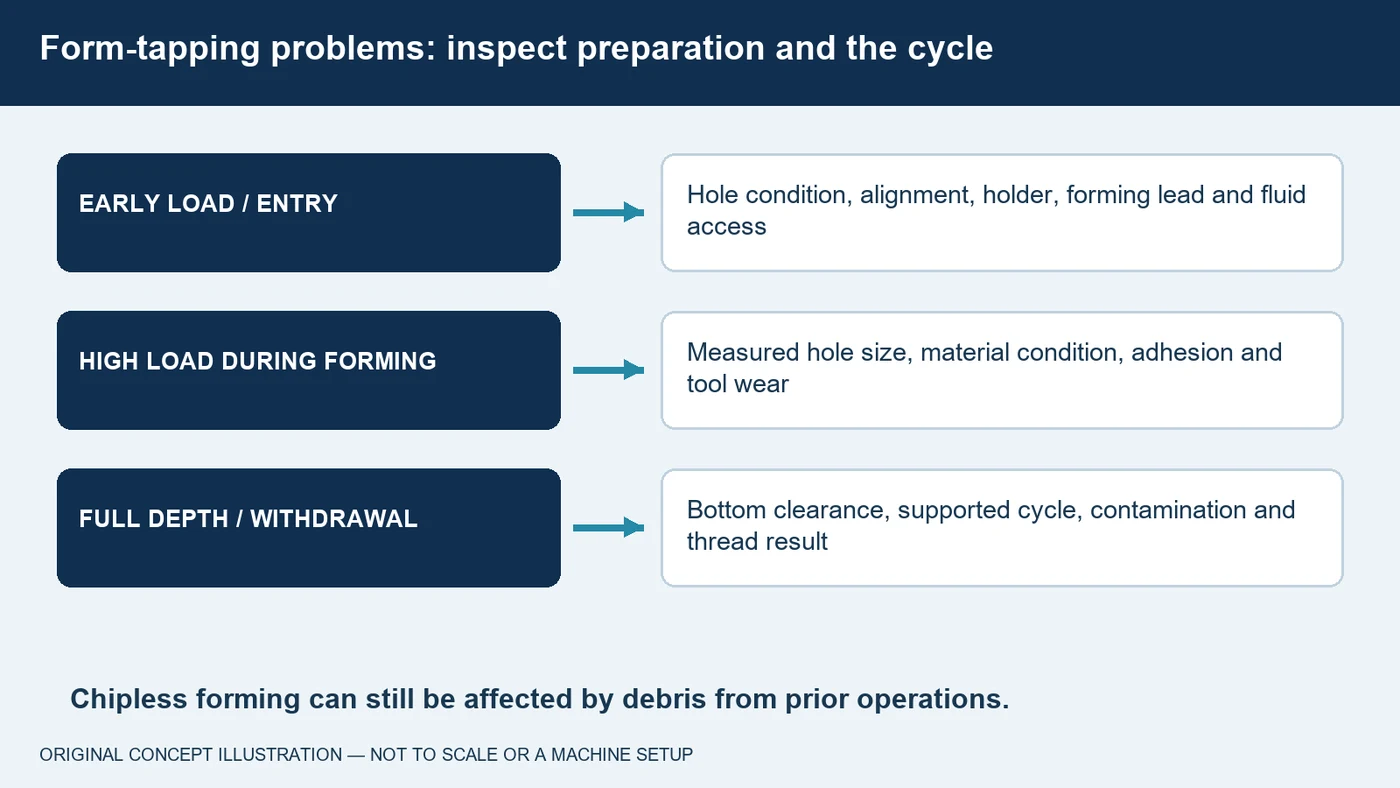
Form tapping can require substantial torque, so confirm the machine, holder and tool arrangement for the selected application. The supported cycle must coordinate spindle and axial motion with the thread lead, including reversal. Do not copy attachment settings from another installation. If load rises or a tool fails, note when it happens: at entry, during forming, near full depth or on withdrawal. Inspect the prepared hole, tool condition, adhesion, alignment and fluid access together. A lubricant cannot correct a tap striking the bottom or a misaligned hole. The absence of newly formed chips does not rule out drilling debris or contamination. Stop safely when the process becomes abnormal, then use the tool and machine guidance to select the next check. A controlled trial should document comparable hole preparation and operating conditions before attributing a result to fluid chemistry.
Inspect the Formed Thread & Maintain the Fluid
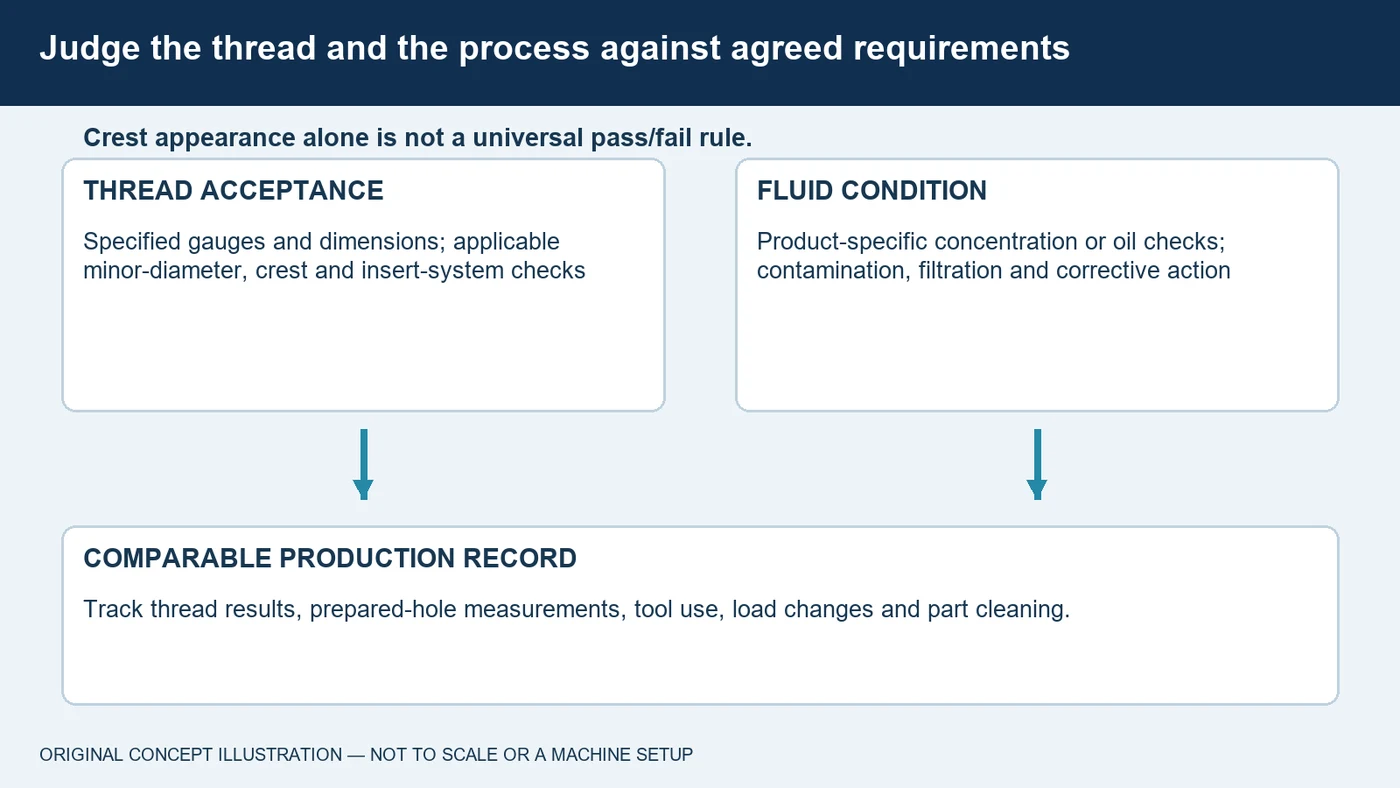
A formed thread can have a different crest appearance from a cut thread. That appearance alone is not a universal pass or fail rule. Inspect the thread using the drawing, applicable standard and agreed quality procedure, including the required gauges and dimensional checks. Insert systems may impose additional minor-diameter or profile requirements. Do not assume that a smooth-looking bore or one gauge result proves every requirement has been met. Maintain the fluid consistently during production and trials. A diluted coolant needs its product-specific concentration method and refractometer factor or table; neat oil uses its own condition checks. Record contamination, top-ups, filter condition and any corrective action. Track thread acceptance, tool use, load changes and cleaning results alongside those fluid records. The useful outcome is repeatable conforming production under the actual application requirements.
Bring QA Your Form-Tapping Application
To discuss a form-tapping lubricant or roll-tapping coolant with QA Lubricants, send the alloy and condition, thread form and size, required depth and blind or through-hole configuration. Include the forming-tap model, prepared-hole recommendation and measured hole condition. Tell us the machine, holder, fluid-delivery arrangement and current product, with the mixture-control method where applicable. Explain the issue: forming load, adhesion, tool life, thread acceptance, residue or cleaning. Add any customer or insert-system restrictions. QA has coolant and cutting-oil options and can help evaluate candidates against the complete application. Confirm the machine, tool and fluid guidance and agree on acceptance criteria before a shop trial. Explore more metalworking guides at QA Lube dot com, or call one, eight seven seven, eight seven seven, six two two one. Thank you for watching.

Fluid selection by material
Use these as evaluation questions, not blanket product approvals.
| Material | What to evaluate | What to confirm |
|---|---|---|
| Ductile wrought aluminum alloys | Evaluate nonstaining lubrication, adhesion control and formed-thread quality. | Exact alloy and temper; do not assume every aluminum casting has suitable ductility. |
| Low-carbon and other suitable steels | Evaluate lubrication, forming load and the prepared-hole condition. | Grade, hardness, ductility, tool maker's material range and thread requirements. |
| Suitable austenitic stainless grades | Evaluate lubrication and resistance to adhesion in the actual process. | Alloy condition, drilled-hole surface, machine capacity and application guidance. |
| Copper and ductile copper alloys | Evaluate nonstaining additive chemistry and formed-thread acceptance. | Exact alloy, active-sulfur compatibility and residue or cleaning restrictions. |
| Brittle, hard or low-ductility materials | Review whether forming is appropriate before discussing a lubricant. | Do not treat a fluid change as permission to form an unsuitable material. |
| Insert threads and restricted processes | Verify the permitted manufacturing method and inspection plan first. | Insert-system guidance, customer specifications, minor diameter and crest requirements. |
Questions about form and roll tapping fluids
Do form taps and roll taps describe the same process?
Both names commonly describe taps that create internal threads by plastic deformation of suitable material. A forming tap does not remove material with chip-cutting edges like a cutting tap.
Can I use the same drilled hole for cut tapping and form tapping?
Do not assume that. Form taps generally require a larger, accurately controlled prepared hole for the same nominal thread. Use the exact tool's recommendation and verify the hole actually produced.
Does chipless tapping mean I can skip cleaning or filtration?
No. The forming step does not create cutting chips, but drilling debris, contamination and other operations can still affect the hole and fluid system.
Are form taps suitable for every metal?
No. The material must have suitable formability, and its condition, tool design and customer process requirements must permit the operation. A family name such as aluminum or stainless steel is not blanket approval.
Can I form a thread for a screw-thread insert?
Check the actual insert-system and customer requirements first. KATO's published guidance generally discourages forming taps for its STI holes because of minor-diameter and crest-profile concerns. Do not assume a standard tapped-hole process is acceptable for an insert hole.
Discuss your application with QA
Read this guide in the QA online store
QA Lubricants has coolant and oil options. Send us the operation, alloy, hardness, tooling, current fluid and the problem you want to solve.
Discuss My ApplicationShop Water Diluted CoolantsShop Straight Cutting OilsTechnical references
- Sandvik Coromant: cutting versus forming taps and forming prerequisites
- Carmex: forming-tap material displacement and prepared-hole requirements
- Carmex: forming-tap characteristics and thread-crest considerations
- Tapmatic: cold-forming materials, lubrication and machine considerations
- KATO Fastening Systems: forming-tap cautions for screw-thread-insert holes
- Vergnano: tapping troubleshooting, lubrication and dimensional checks
- QualiChem: coolant formulations for machining and tapping applications
- QualiChem: straight cutting-oil formulations and application families
- Blaser Swisslube: product-specific concentration measurement
Original educational content and illustrations. Confirm current machine, tool and fluid instructions. Trademarks belong to their respective owners.