QA Lubricants homepageMetalworkingVideo Library
QA MACHINING GUIDE

Lapping Fluids, Oils and Vehicles for Precision Metal Finishing

Lapping fluid and vehicle selection for metal seal faces and precision parts: abrasive slurry, lap conditioning, metered supply, contamination control and flatness inspection.

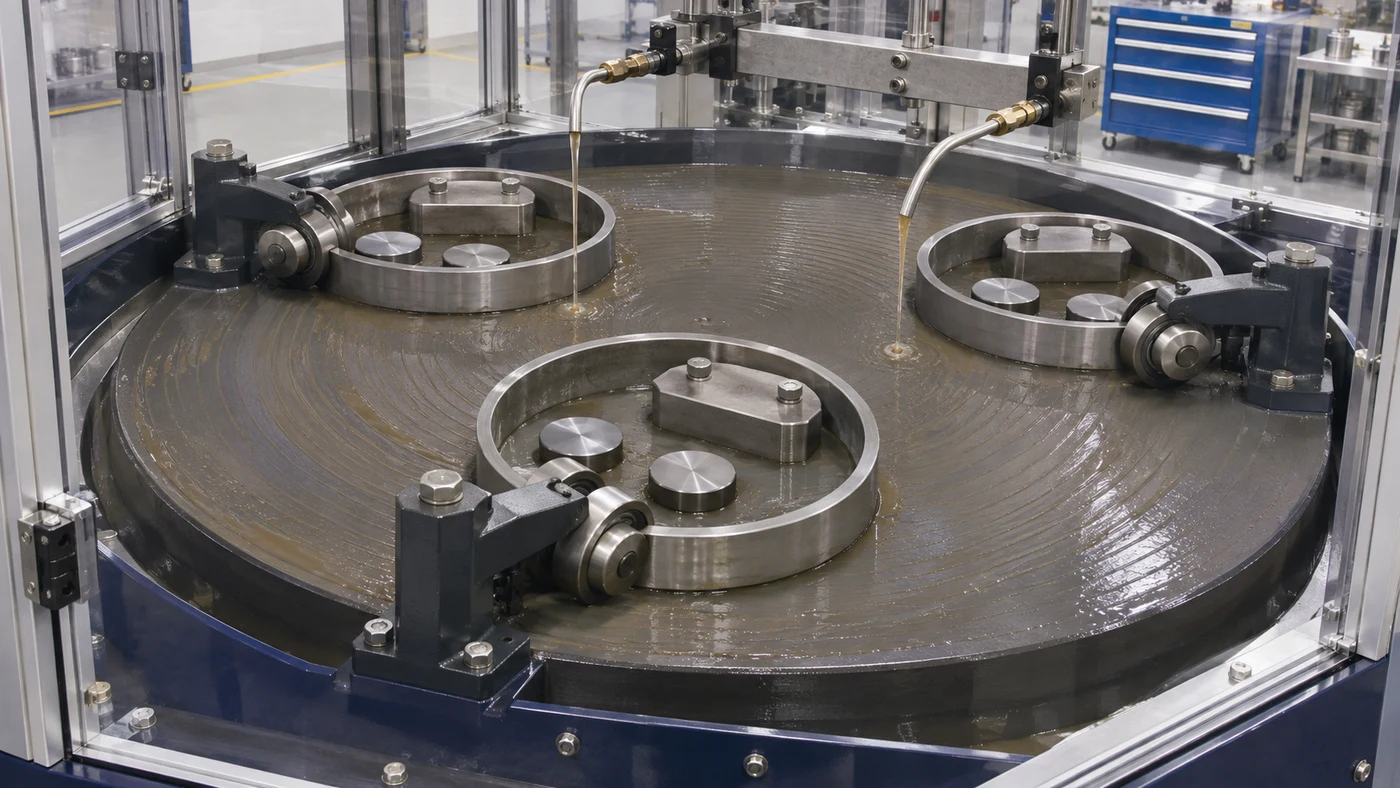
Original illustrative flat lapping machine with ring-held metal parts and a controlled slurry supply

Watch: Lapping Fluids, Oils and Vehicles for Precision Metal Finishing

Lapping Fluids and Vehicles for Precision Metal Finishing

Lapping uses abrasive action between a workpiece and a lap to produce a specified surface and geometry. In a conventional flat-lapping machine, parts are held within rings or carriers while the plate moves beneath them and a controlled abrasive slurry reaches the interface. Diamond systems can also use a plate charged with abrasive. The fluid supports the process, but it is not a substitute for selecting the correct abrasive, plate and workholding. Applications include metal seal faces, valve components and precision flat parts. This guide focuses on flat lapping; spherical and bore lapping need their own tooling and acceptance plans. QA has coolant and oil options for evaluation. Begin with the material and required result before choosing a lapping fluid or vehicle.

Original illustrative flat lapping machine using a metered fluid supply and ring-held metal parts

Separate the Abrasive, Vehicle and Added Lubricant

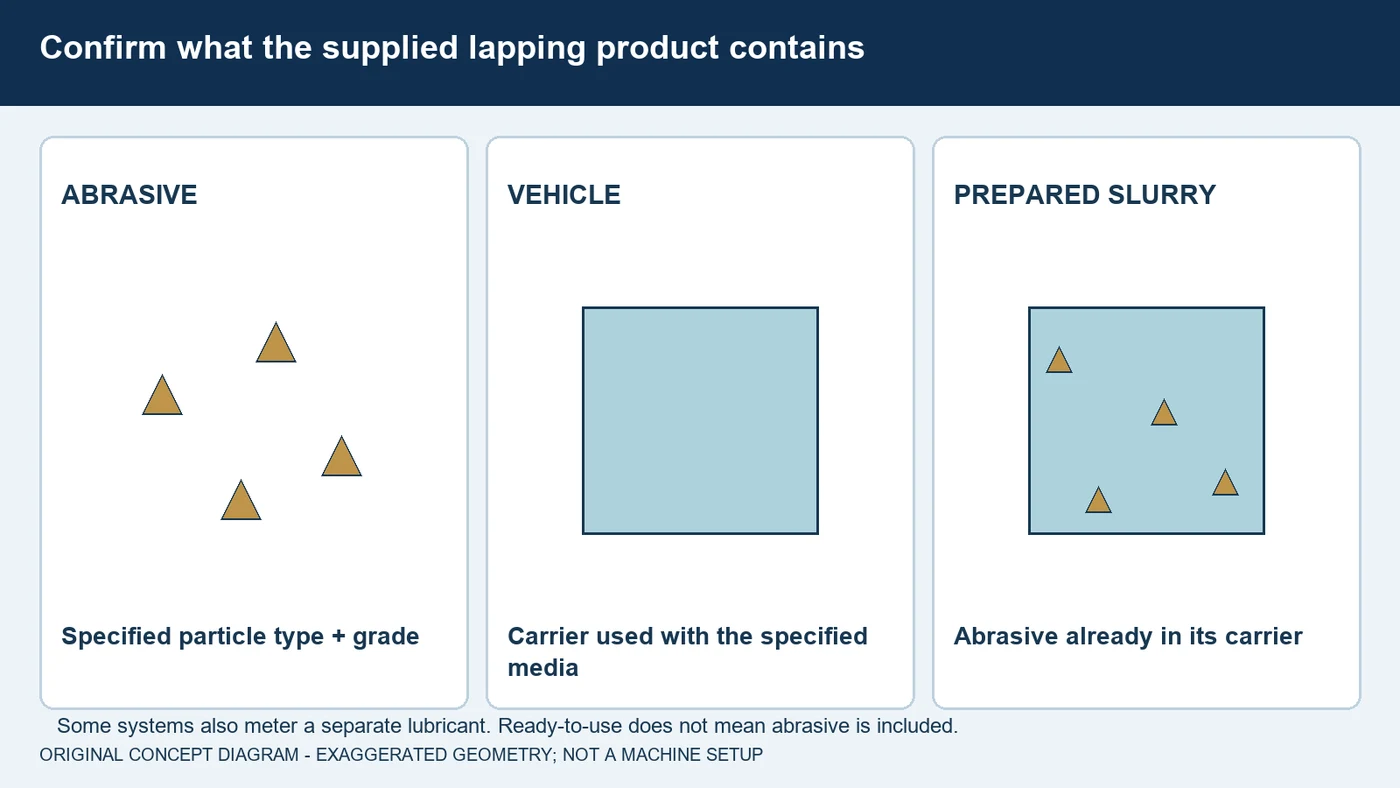
A lapping vehicle is a carrier used with the specified abrasive. A prepared abrasive slurry already combines particles with a formulated carrier, while some diamond systems meter a separate lubricating fluid alongside the abrasive product. These terms should not be treated as interchangeable instructions. Confirm whether a supplied fluid is ready for its intended use, requires dilution, or needs separately added abrasive. Oil-based, water-based and emulsion formulations are available for different systems. Viscosity, suspension behavior, wetting, material compatibility and later cleaning influence the choice. Follow the actual product and machine instructions for preparation and agitation. Adding extra oil, water or powder by appearance can change the working mixture. QA can help evaluate the fluid requirement once the abrasive and process are identified.

Original formulation concept distinguishes abrasive particles, carrying vehicle and a prepared slurry

Match Abrasive Size and Plate to the Material

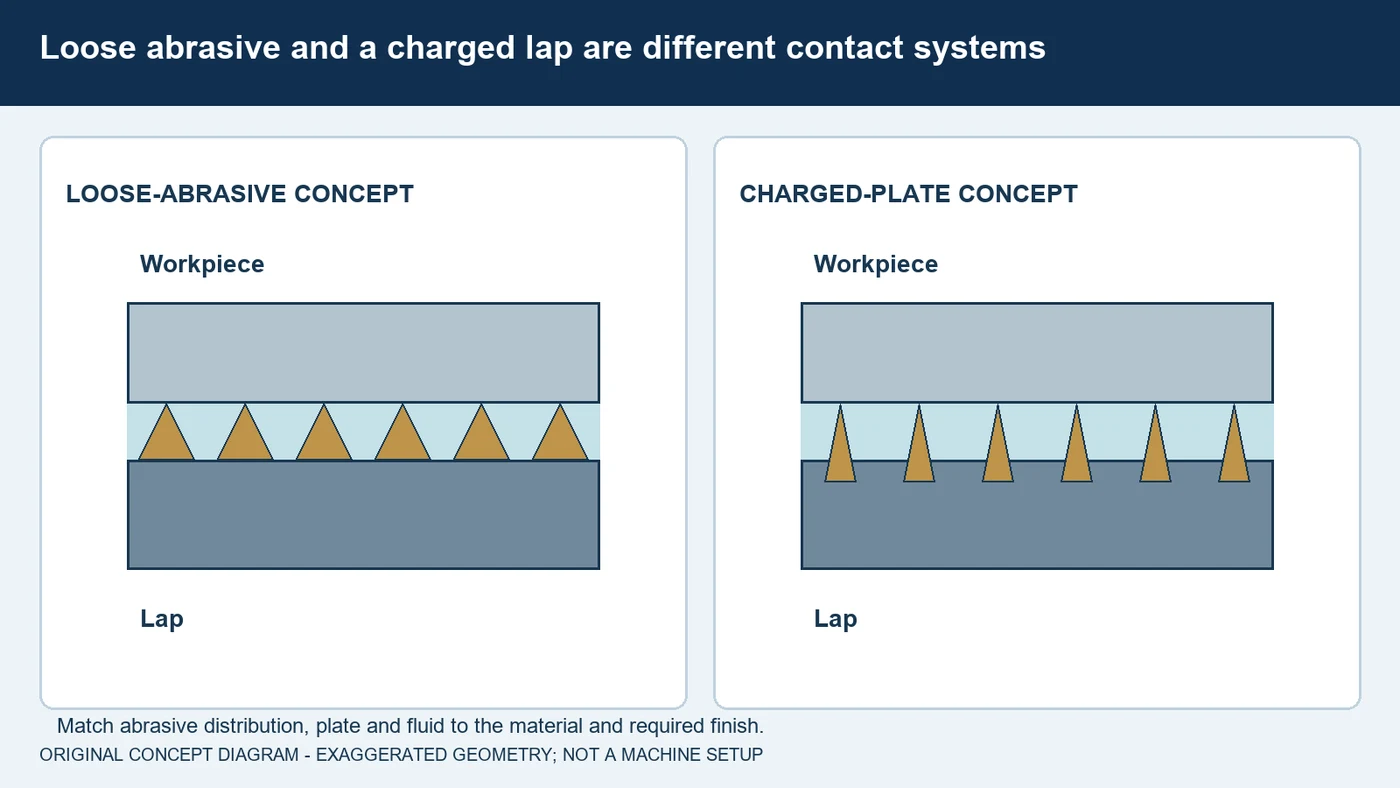
Conventional lapping can use abrasives such as aluminum oxide or silicon carbide; diamond systems use controlled diamond particle grades. Nominal grit or micron size alone does not define the whole application. Particle-size distribution and oversized contamination affect the possibility of isolated scratches. The plate material and the way abrasive interacts with it also matter. A composite plate intended to accept diamond is a different working surface from a conventional cast-iron lap. Select the complete combination for the alloy, hardness, coating, stock allowance and desired finish. Do not transfer a grinding-wheel abrasive rule directly to loose-abrasive lapping. Use the qualified sequence and inspect the result before moving to a finer step. A finer slurry is not an automatic cure for deep incoming defects.

Original contact section contrasts loose abrasive with a charged composite lap and labels the workpiece

Maintain the Lap and Support the Part Correctly

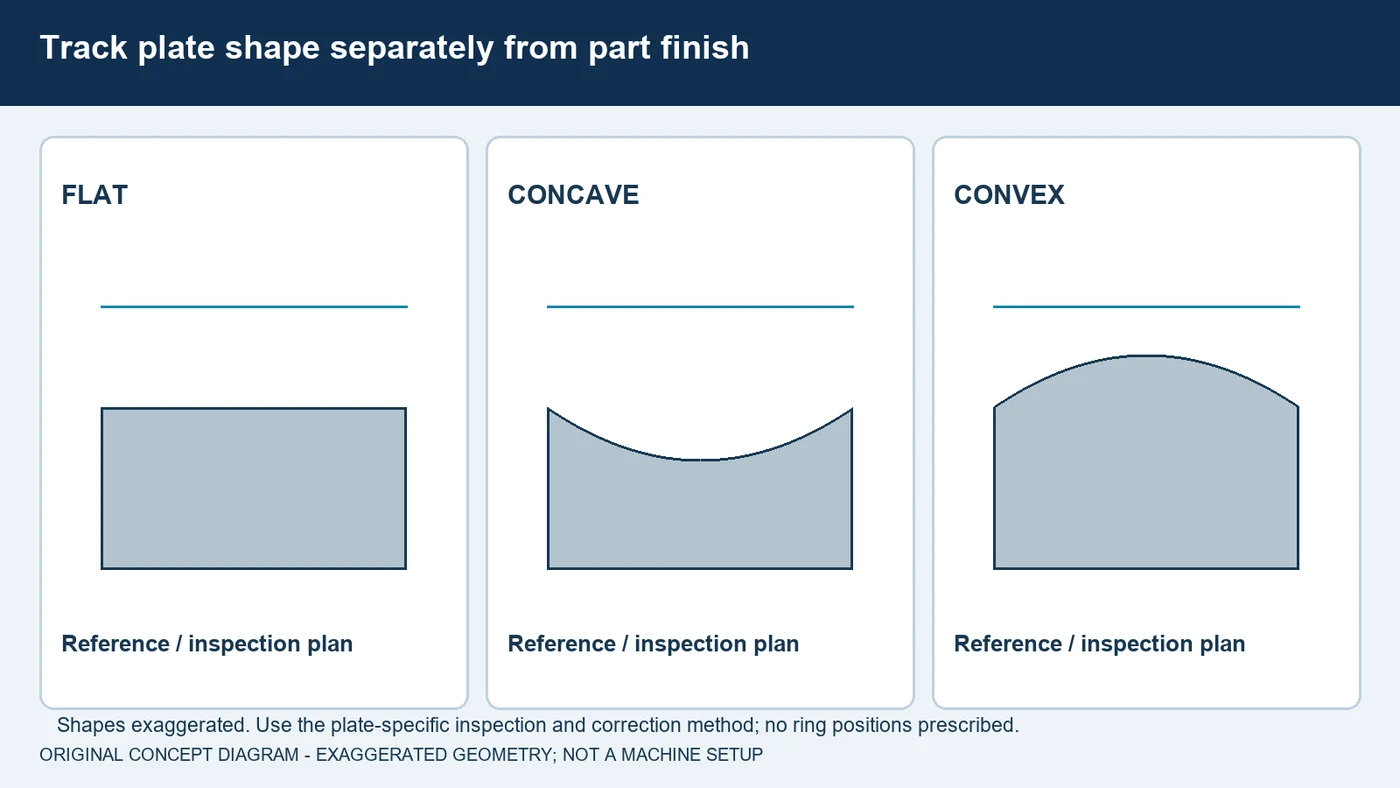
A lap plate is a working tool that changes with use. Wear and conditioning influence its form, so the maintenance plan must include plate checks at the appropriate locations and intervals. A measurement over one gauge span is not automatically the total flatness of a large plate. Follow the equipment supplier's method for interpreting readings and correcting the plate. Ring or carrier position, condition and workpiece loading belong to that review. Thin or flexible components also need support that does not introduce unacceptable distortion. Keep conditioning material and production abrasive under separate control, and clean as instructed after correction. Changing the fluid cannot compensate for every plate-shape or fixture problem. Document plate condition alongside part results during a lapping-fluid trial.

Original exaggerated plate profiles distinguish flat, concave and convex conditions without prescribing ring positions

Meter the Working Mixture and Keep Its Composition Consistent

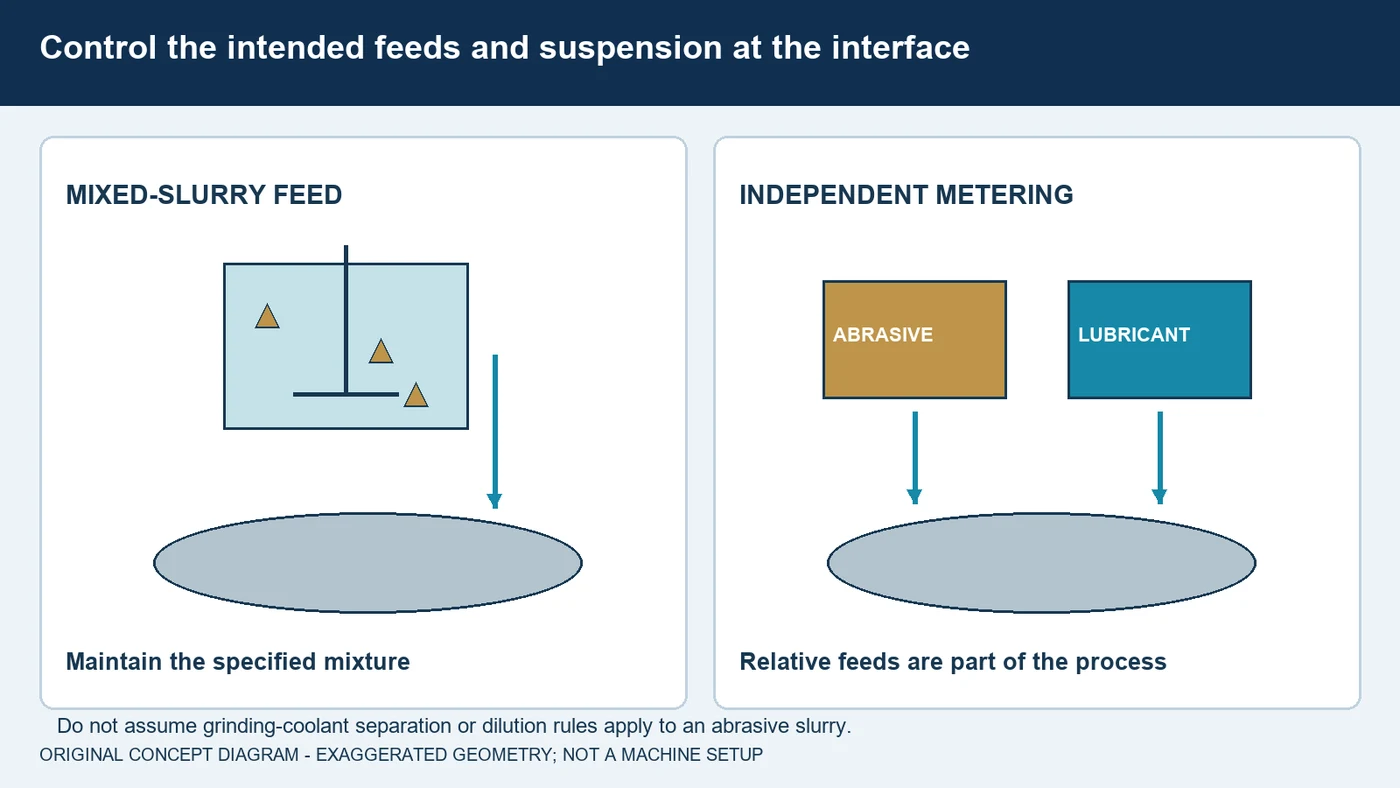
The supply system has to deliver the intended working mixture, not just wet the plate. Some machines pump an agitated conventional slurry; others independently meter diamond product and lubricating fluid. Check the actual feed path, dispensing condition and the product's suspension instructions. Excess supply, starvation or a change in the relative feeds can alter the interface. Keep preparation and additions repeatable, and record consumption during a trial. If the system reuses fluid, confirm how its composition and contamination will be controlled. Unlike a grinding coolant, the lapping mixture may intentionally contain cutting abrasive. A separation step chosen without that distinction could change the process. Follow the qualified arrangement rather than applying a generic fine-filtration or dilution recipe.

Original supply concept separates a mixed-slurry feed from independent diamond and lubricant metering

Prevent Coarse-to-Fine Contamination and Residue Damage

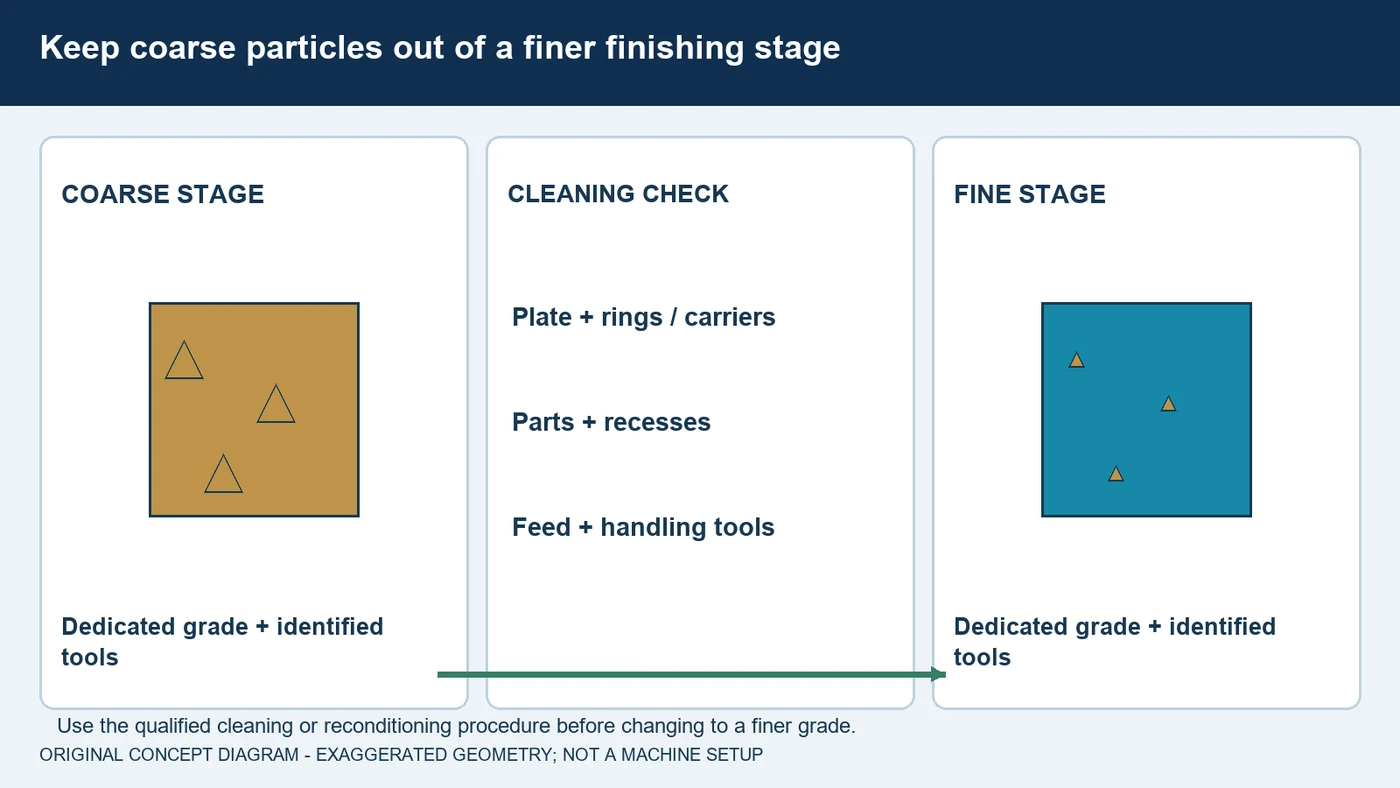
One coarse particle can be a problem in a fine finishing stage. Identify abrasive grades, containers, dispensing equipment and cleaning tools so a previous step does not contaminate the next. Follow the plate-specific cleaning or reconditioning procedure when changing grades, especially when moving finer. Clean conditioning residue from the plate and rings before production. Check fixtures, workpiece recesses and handling surfaces as well as the obvious working face. Soft metals and porous or textured features may need particular attention to retained residue and the approved cleaning method. A visually clean surface does not prove every cleanliness requirement. Verify the specified final cleaning, corrosion protection and downstream compatibility before storage, coating or assembly. Keep cleaning and handling conditions comparable when evaluating a new lapping fluid.

Original segregation diagram shows separate coarse and fine tools with a cleaning checkpoint between stages

Verify Flatness, Thickness and Surface Texture Separately

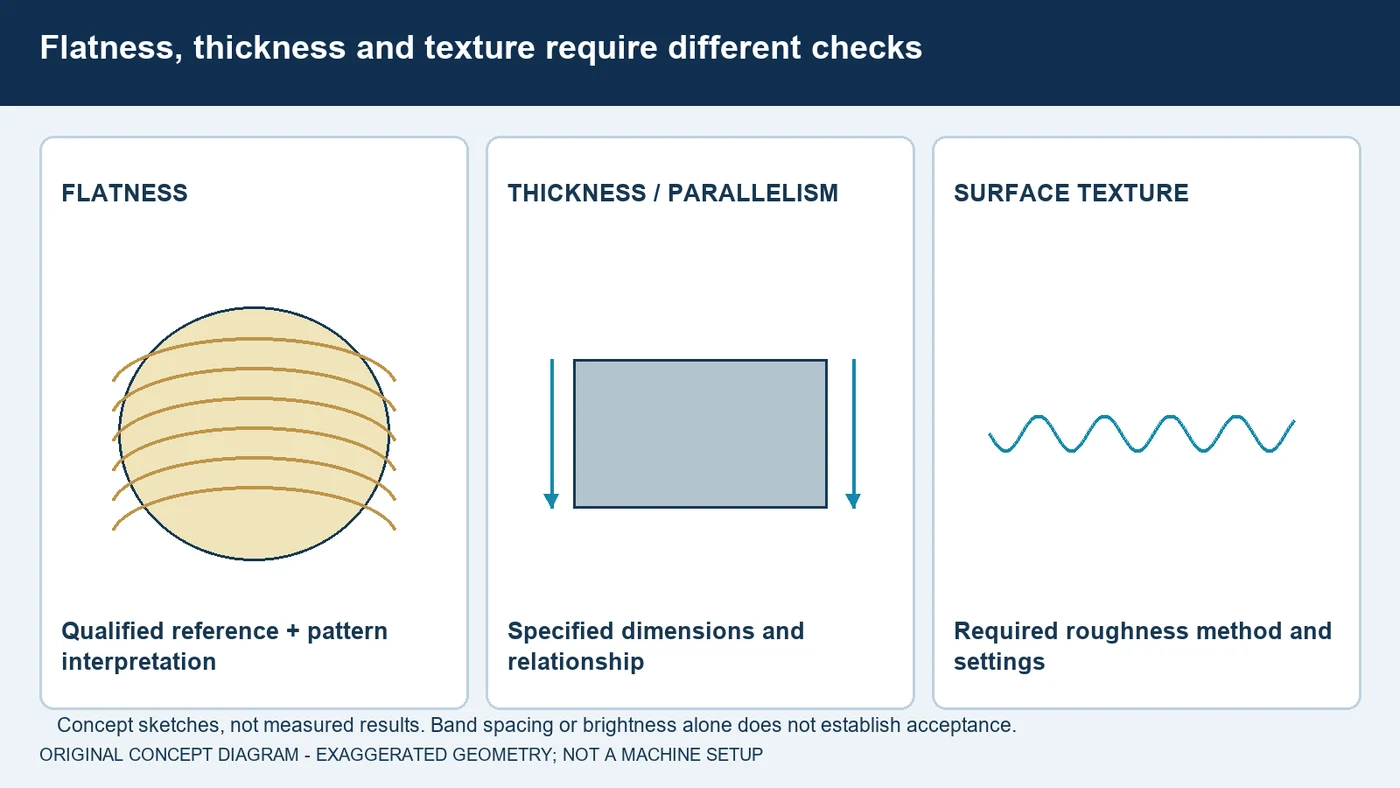
A fine surface finish and a flat surface are different acceptance questions. Inspect the required flatness, thickness, parallelism and texture using methods suited to the part. Optical flats with a suitable monochromatic light can show interference patterns on a sufficiently reflective surface. Cleanliness, reference-flat condition and correct interpretation are essential. Simply counting every visible straight band does not establish the flatness error; use the qualified interpretation of the pattern and reference. Do not assign a universal length to a light band without the measurement method and wavelength. Surface roughness also needs its own specified direction, filters and settings. A bright seal face may still have unacceptable geometry or damage. Verify the complete drawing and cleaning requirements before accepting the part.

Original inspection concepts separate optical-flat pattern, thickness relationship and fine surface texture

Plan a Controlled Lapping-Fluid Evaluation

Send QA the part drawing, alloy, hardness or coating, incoming condition and permitted stock removal. Identify whether the operation is single-sided flat lapping, double-sided work or another geometry. Provide the plate, ring or carrier, workholding, abrasive type and grade, and the qualified preparation sequence. Include current vehicle or slurry, any separately metered lubricant, feed arrangement, temperature and maintenance records. Describe the problem with geometry measurements, surface data and consistent photographs. QA has coolant and oil options for evaluation. Agree on a trial that follows accepted geometry, finish, abrasive consumption, working-mixture condition and cleanability together. Keep plate condition and inspection methods comparable. Confirm the final fluid and handling instructions with the machine and abrasive suppliers before changing production.

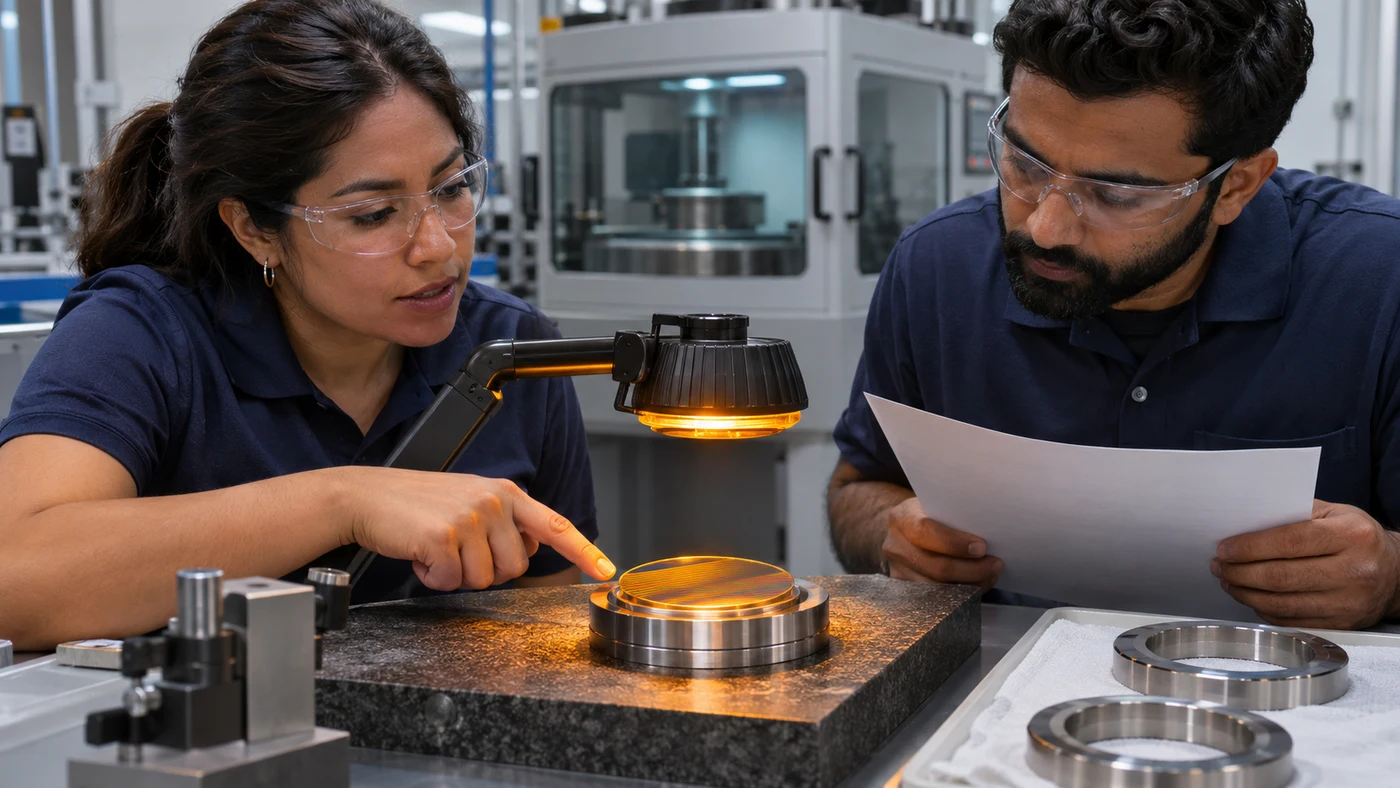
Original illustrative diverse quality team reviews a cleaned metal seal face beneath an optical-flat inspection lamp

Fluid selection by material

Use these as evaluation questions, not blanket product approvals.

MaterialWhat to evaluateWhat to confirm
Carbon, alloy and hardened steelIdentify hardness, incoming machining marks, stock allowance and required geometry.Qualified abrasive/plate combination, fluid compatibility, cleanliness and corrosion protection.
Stainless steel and nickel alloysReview the exact alloy, cutting behavior and required finish or sealing function.Complete abrasive and vehicle system, plate condition, residue removal and acceptance measurements.
Aluminum, copper alloys and other softer metalsEvaluate distortion, edge condition, staining and retained abrasive or residue.Compatible carrier and lap, controlled support, cleaning method and specified surface condition.
Coated metal components and hard seal materialsIdentify the actual layer or material and permitted removal, rather than using the substrate alone.Qualified abrasive, lap and fluid, remaining coating, edge control and final cleaning.

Questions about lapping fluids

What is a lapping vehicle?

A carrier used with a specified abrasive. A prepared abrasive slurry already combines abrasive and carrier; a separate lubricating fluid may have another role. Check the supplied product instructions.

Is ready-to-use lapping fluid the same as abrasive slurry?

Not necessarily. Ready-to-use describes the supplied fluid preparation, not whether it contains abrasive. Confirm the product contents and the machine process before adding media or diluting.

Can oil-based and water-based vehicles be exchanged?

Do not assume so. Verify compatibility with the abrasive, lap, supply system, material and downstream cleaning requirements.

Will a finer abrasive fix an out-of-flat part?

Not by itself. Review plate form, support, loading, incoming geometry and the qualified removal sequence as well as abrasive grade.

Does a mirror finish prove flatness?

No. Flatness, thickness or parallelism, texture and cleanliness are separate requirements and need suitable inspection.

Which QA lapping fluid should I use?

QA has coolant and oil options. Provide the material, operation, lap, abrasive, feed system and acceptance requirements for evaluation.

QA lapping fluids and vehicles

Ready-to-use lapping fluids: QA Lapping 6201, 6208 and 6250 are finished mineral-oil-based products, supplied at working strength for lapping and honing applications.

Lapping vehicles: FW Lapping Vehicle, Aqua Lap 74 and Aqua Syn G-Cut provide three carrier choices for use with lapping media in the lapping machine. Match the vehicle to the abrasive, machine and workpiece.

Mineral oil · Added lubricity

QA Lapping 6201

A very thin, ready-to-use mineral-oil fluid with added lubricity for precision lapping and honing. A low-viscosity option when the process calls for a freely flowing lubricating fluid.

Fluid profile: Very thin, with added lubricity.

View product in our store

Mineral oil · Higher viscosity option

QA Lapping 6208

A finished mineral-oil lapping fluid with an additive package similar to Lapping 6201. Its slightly higher viscosity provides another option for processes requiring a thicker fluid.

Fluid profile: Slightly thicker in viscosity than 6201.

View product in our store

Mineral oil · Sulfurized additive

QA Lapping 6250

A super-thin, ready-to-use mineral-oil fluid with a sulfurized additive for lapping and honing. Review the additive package with QA to match your workpiece material and finishing requirements.

Fluid profile: Super-thin, with a sulfurized additive.

View product in our store

Mineral-oil vehicle

FW Lapping Vehicle

A mineral-oil-based vehicle for use with lapping media. Provides an oil-based carrier option for preparing a lapping mixture matched to the machine, abrasive and workpiece.

Selection: Confirm abrasive type, loading and application requirements with QA.

Ask about this vehicle

Water-dilutable gel

Aqua Lap 74

A clear, water-dilutable gel formulated to suspend lapping abrasives, including silicon carbide (carborundum), aluminum oxide and polycrystalline synthetic diamond.

Contains lubricity and wetting additives plus rust inhibitors for water mixes.

Starting mixture: 2 parts Aqua Lap 74 to 3 parts water. Adjust for the type and amount of abrasive used.

Ask about this vehicle

Glycol-based gel

Aqua Syn G-Cut

A glycol-based gel vehicle for use with lapping media in the lapping machine. An alternative carrier chemistry to the mineral-oil and water-based choices.

Selection: Confirm abrasive compatibility, mixing requirements and machine suitability with QA.

Ask about this vehicle

Why the fluid matters

In lapping, lubrication helps absorb frictional heat and disperse lapping residue. In honing, a low-viscosity oil helps flush fine swarf and keep honing stones clean. Consider fluid viscosity and delivery alongside the abrasive or stone, workpiece material, machine settings and required finish.
Shop ready-to-use fluidsAsk about lapping vehicles

Discuss your application with QA

QA Lubricants has coolant and oil options. Send us the operation, alloy, hardness, tooling, current fluid and the problem you want to solve.

Discuss My ApplicationShop Lapping FluidsShop Water Diluted CoolantsShop Straight Cutting Oils

Technical references

Original educational content and illustrations. Confirm current machine, tool and fluid instructions. Trademarks belong to their respective owners.