
Metal Drilling Cutting Oils & Coolants
Understand CNC drilling coolant delivery, chip evacuation, blind and through holes, material compatibility and drilling-fluid troubleshooting with QA Lubricants.

Watch: Metal Drilling Cutting Oils & Coolants
Drilling Coolant Has to Reach the Cut
Why does a metal drilling operation need more than a splash of coolant at the surface? As the drill enters the workpiece, its cutting edges move into a confined space. Fluid has to support cooling, lubrication and chip removal where the work is happening. A wet-looking machine does not prove that the drill point has the delivery it needs. In this QA Lubricants guide, we look at CNC drilling coolant, cutting oil, hole geometry and practical troubleshooting. We cover conventional metal drilling; specialized deep-hole and gun-drilling systems deserve their own application review. QA has coolant and oil options. The useful starting point is the actual alloy, drill and hole, followed by a controlled evaluation. Our original images and diagrams explain principles rather than prescribe a machine setup.
Identify the Hole & the Drill
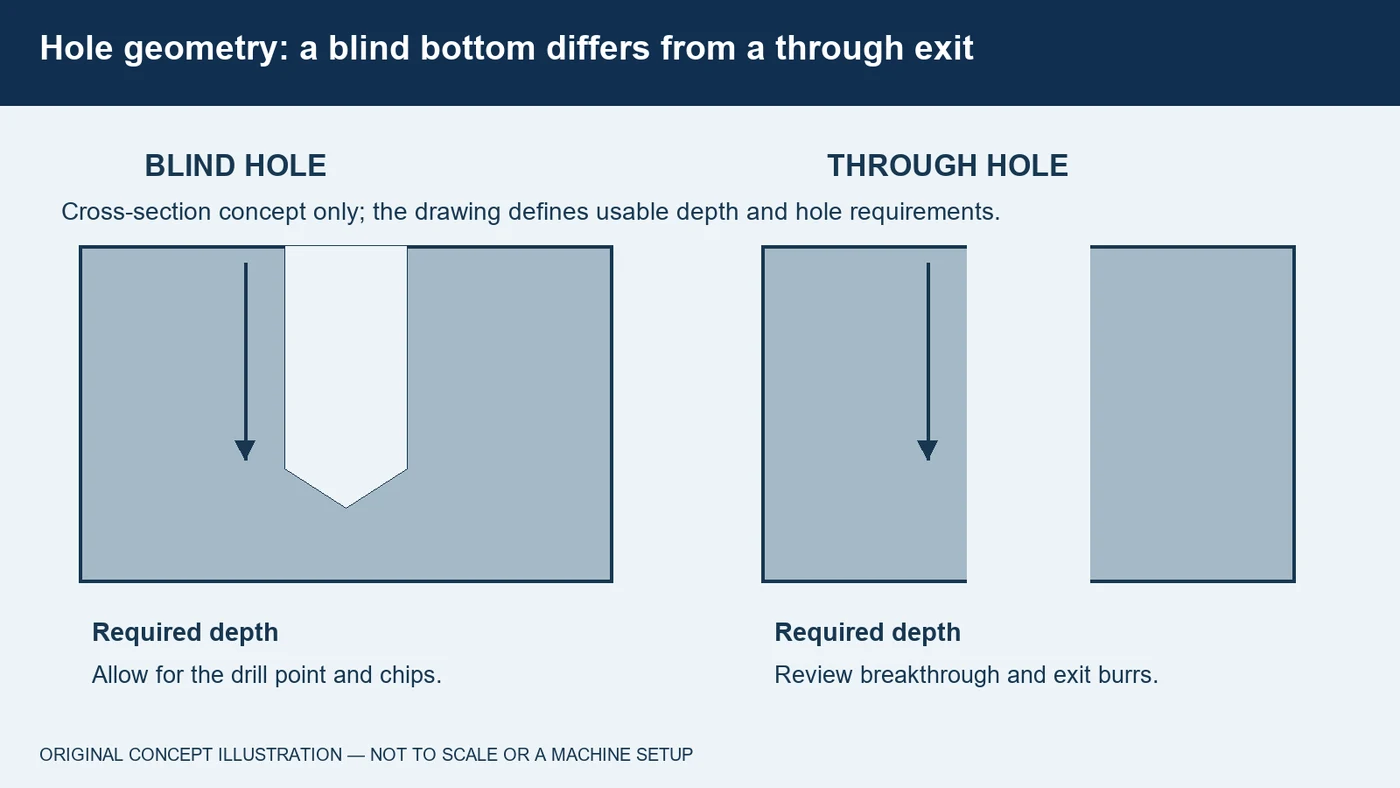
Begin with the drawing and the tool. Record the hole diameter, required depth, entry surface and whether the hole is blind or passes through the part. A blind hole needs room for the point and chip management near its bottom. A through hole adds exit behavior and burr requirements. Cross holes, angled entry and interrupted exits deserve specific tool guidance. Also identify the drill construction: high-speed steel, solid carbide, replaceable tip or indexable insert. These are not interchangeable process instructions. Hold the work securely and review the holder, runout, overhang and machine alignment before changing the fluid. A hole that later receives a reamer or tap may have different size and surface requirements from an ordinary clearance hole. Give QA those details so the fluid discussion reflects the whole sequence, not just the first drilling pass.
External & Through-Tool Coolant Delivery
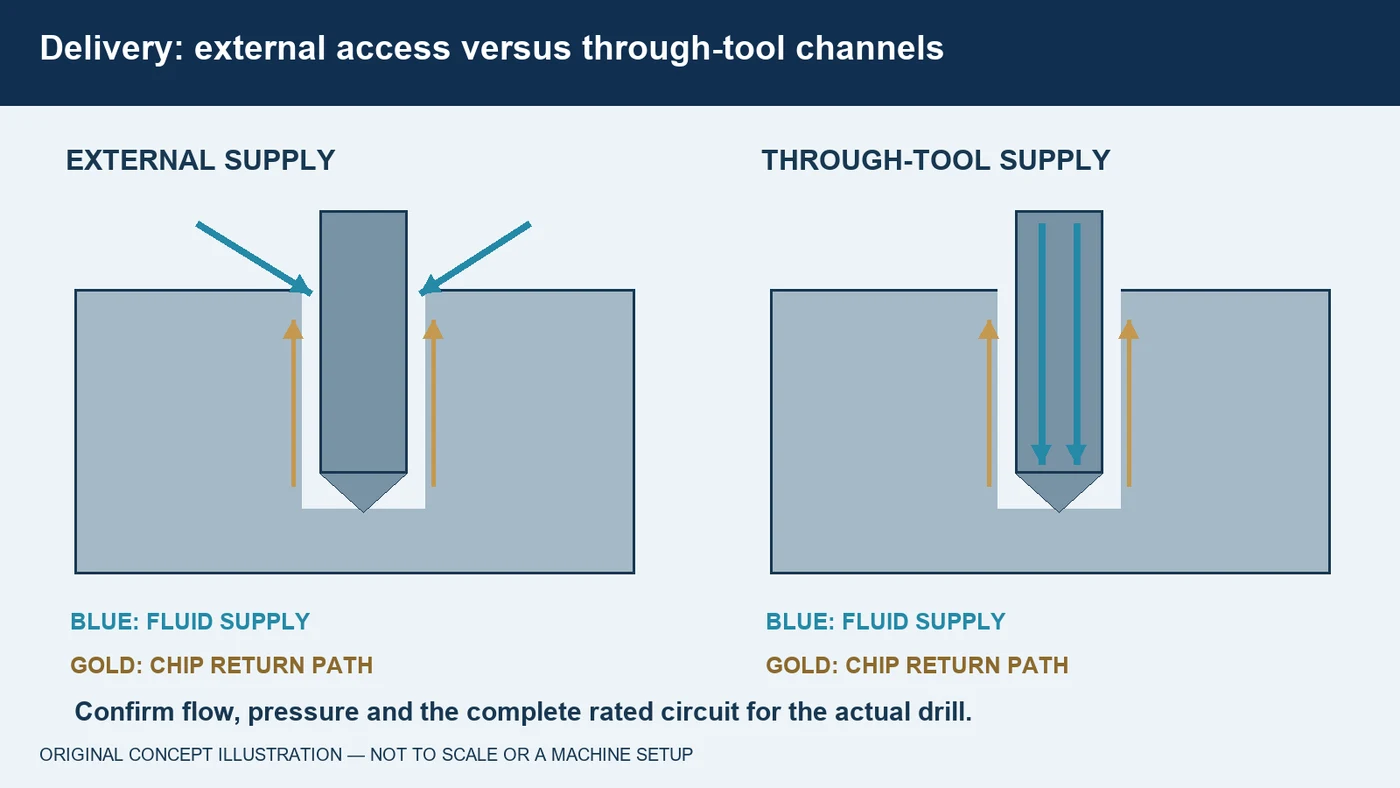
External nozzles direct fluid toward the drill and hole entrance. Through-tool coolant travels through internal channels and emerges near the working end, giving access where an external stream may struggle to reach. That distinction becomes especially important as the cutting point moves farther into the part. The complete circuit matters: tank level, filters, pump, spindle or holder connections and the drill outlets. A pressure reading at the pump is not proof of adequate delivery at the tool. Check the actual supply arrangement against the drill and machine requirements. More pressure is not permission to exceed the rating of a hose, seal or connection. Use the approved inspection procedure rather than opening an enclosure or reaching near a running tool. Minimum quantity lubrication is another engineered delivery method for compatible tools and equipment; it is not simply an ordinary flood system with the flow turned down.
Chip Evacuation & the Drilling Cycle
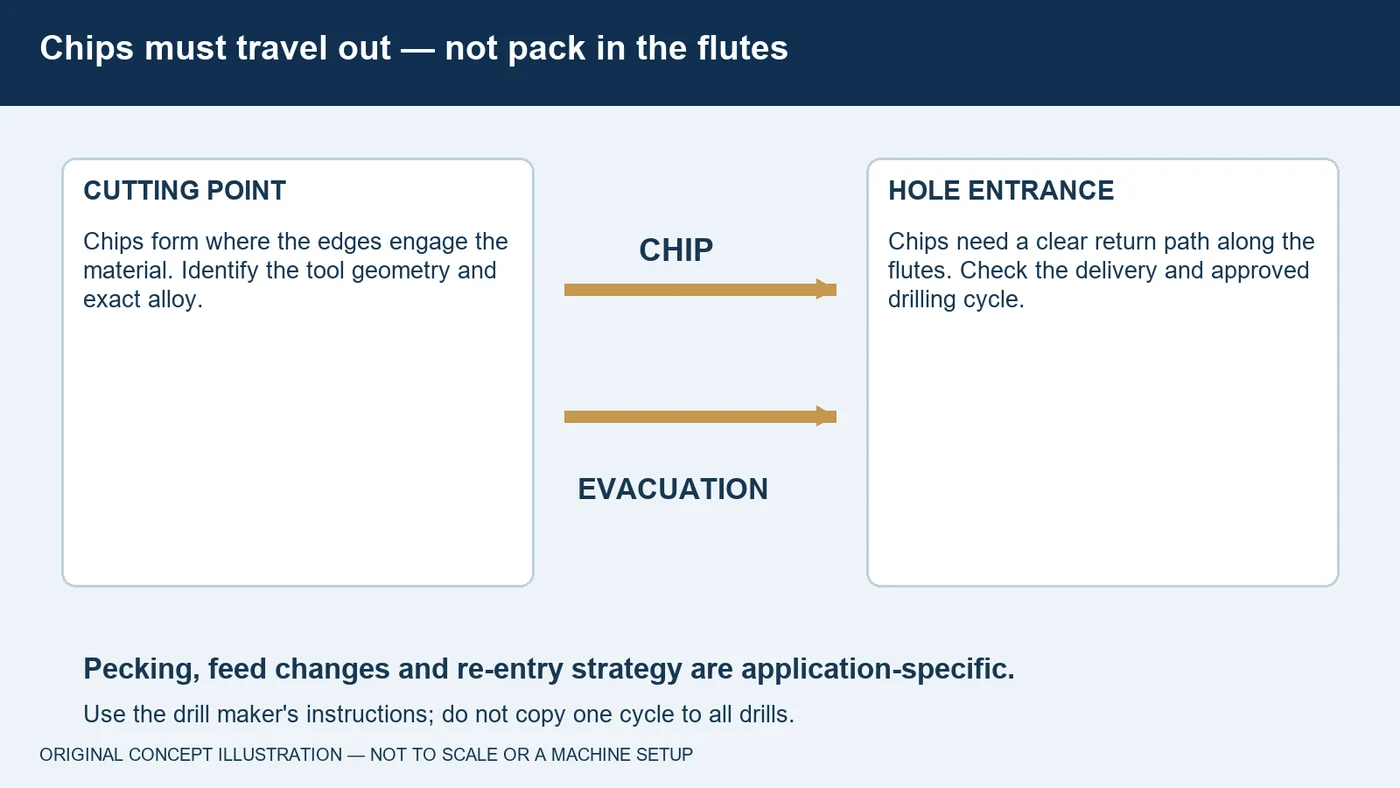
A drill makes chips at the cutting edges and needs space for those chips to leave along its flutes. Packed chips can interfere with the cut and damage the tool or hole. Look at chip shape and the location of the problem, not only the amount of coolant visible outside the workpiece. Tool geometry, flute space, cutting conditions and fluid delivery all influence evacuation. A feed change that helps one material or drill may be wrong for another. Use the maker's application guidance to interpret the evidence. Peck cycles are also application-specific. Some tool and hole combinations use them to clear chips; others require a different strategy. Do not copy one cycle across all drills or repeatedly dwell in the hole without guidance. Stop the process safely when chips pack or abnormal load appears, and investigate before another part or tool is lost.
Choose Fluid for the Material & System
Water-miscible drilling fluids include soluble oils, semi-synthetics and solution synthetics, with additional formulations using GTL or vegetable-derived components. Straight cutting oils are used without water dilution where the machine and process permit them. The family name is only a starting point; actual formulations have different application ranges. Aluminum raises questions about adhesion, staining and finishing. Stainless steel needs attention to chip formation and the cutting process, while titanium and nickel alloys require specialist review. Brass and other copper-containing alloys need compatible additive chemistry, including active-sulfur considerations. Cast irons differ from one another in chip and wear behavior. Match the product to every material in a shared system and to downstream cleaning. Neither an oil-rich appearance nor a clear-looking coolant proves that it will solve the application. Confirm requirements and test a suitable candidate against an agreed baseline.

Read the Symptom Before Changing the Fluid
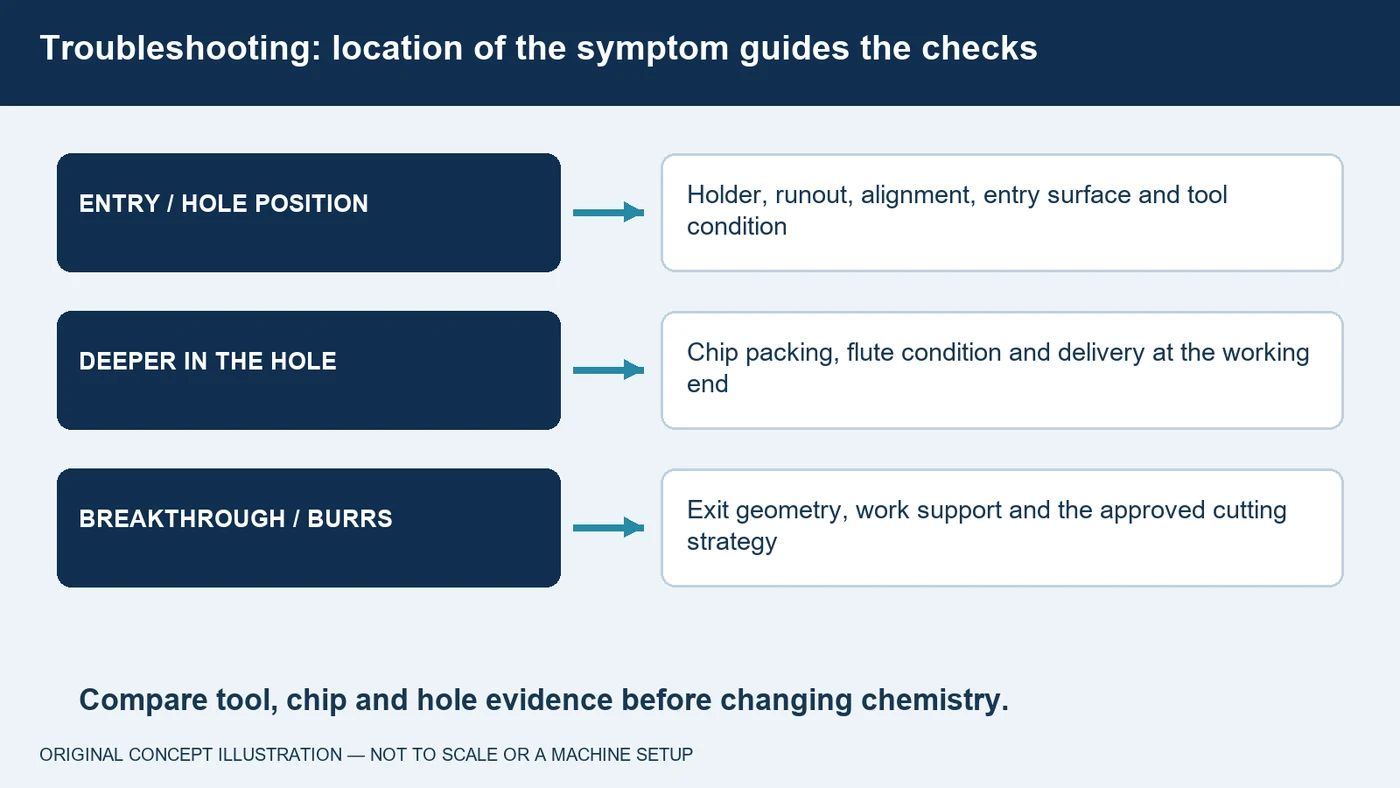
An oversized hole, poor finish or short drill life can have several causes. Inspect cutting edges, margins, holder condition and runout along with chip evidence and fluid delivery. A problem at entry is different from one that appears near full depth or only at breakthrough. Adhesion on the tool suggests different questions from packed flutes, chipped edges or alignment errors. A coolant change cannot repair a worn holder or correct an unsupported drilling strategy. Record the current tool, cutting conditions, hole measurements and fluid condition before making changes. Then use the drill supplier's guidance to select the next check. A controlled trial should compare acceptable hole quality, tool life, chip evacuation and downstream operations under comparable conditions. Avoid judging a new fluid by one good hole or attributing every improvement to chemistry when the tool or program also changed.
Keep the Fluid & Supply System Consistent
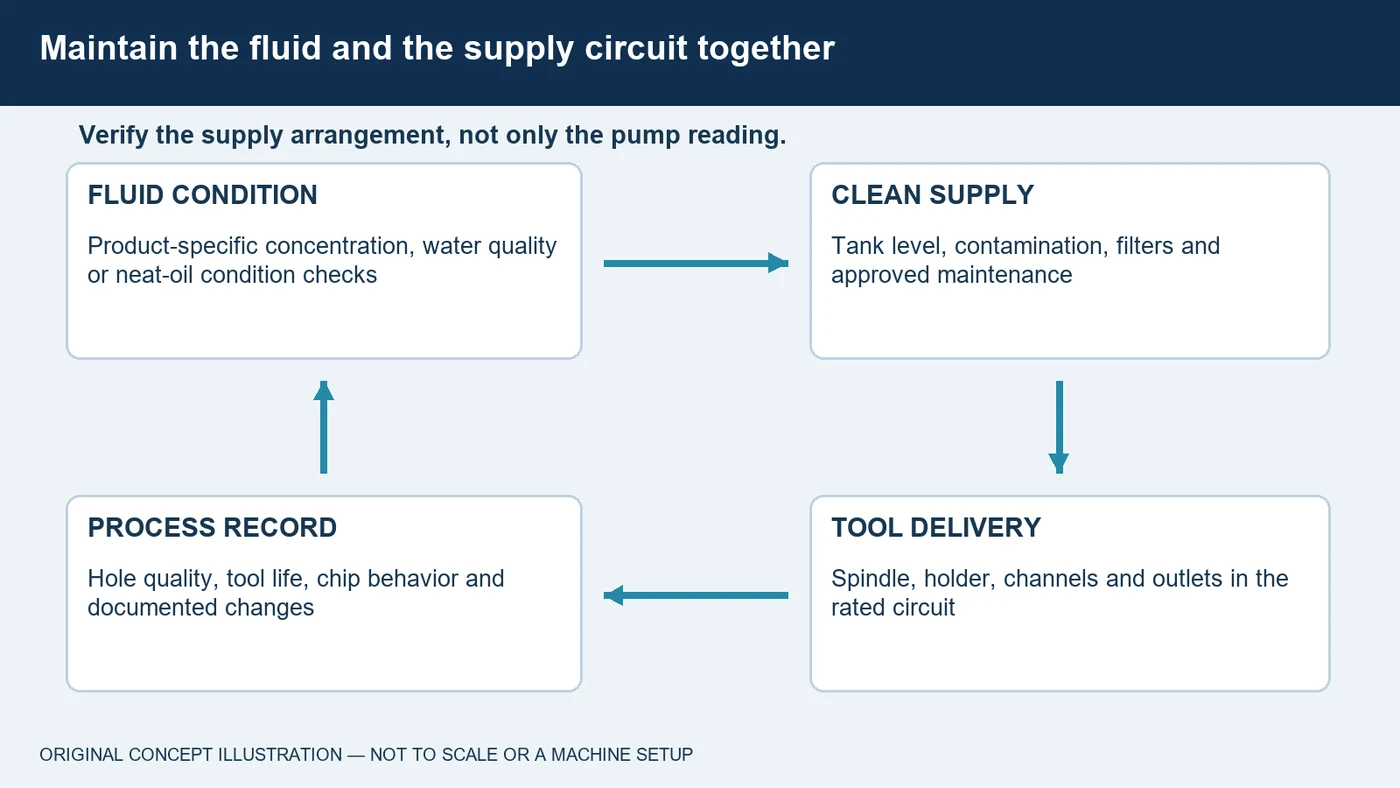
Drilling performance depends on consistent fluid condition as well as the original selection. For a water-miscible coolant, use the product's specified concentration range and the correct refractometer factor. A refractometer reading alone is not automatically the actual mixture percentage. Follow the supplier's mixing, water-quality and maintenance instructions instead of adding concentrate or an additive by guesswork. Check filtration, tank level, contamination and the delivery circuit using the machine's procedure. Small internal coolant channels make clean supply especially relevant; Guhring's micro-drill guidance is one example of tools relying on those channels to support evacuation. Neat cutting oil requires its own condition checks rather than a water-dilution measurement. Keep records of the fluid, top-ups and changes so a drilling problem can be compared with the operating history. Use approved handling and maintenance practices for the complete system.
Bring QA Your Drilling Application
When you contact QA Lubricants about a metal drilling coolant or cutting oil, send the alloy and hardness, drill type and diameter, hole depth and whether it is blind or through. Include the machine, holder, internal or external delivery, current product and mixture control where applicable. Tell us what needs to improve: chip packing, finish, burrs, hole size, tool life or fluid condition. Add any restrictions on residues, additives or the customer's manufacturing process. QA has coolant and cutting-oil options and can help evaluate candidates with the machine and tooling requirements in view. Confirm application guidance before a controlled shop trial. Explore more machining guides at QA Lube dot com, or call one, eight seven seven, eight seven seven, six two two one. Thank you for watching this QA Lubricants guide to metal drilling fluids.

Fluid selection by material
Use these as evaluation questions, not blanket product approvals.
| Material | What to evaluate | What to confirm |
|---|---|---|
| Carbon and alloy steel | Evaluate chip formation, lubricity, corrosion protection and tool wear. | Exact grade, hardness, tool geometry and the maker's cutting-data window. |
| Austenitic and duplex stainless steel | Evaluate lubrication and reliable chip evacuation in the actual hole. | Material condition, work-hardening concerns, tool geometry and delivery. |
| Aluminum alloys | Evaluate resistance to adhesion, nonstaining compatibility and chip clearance. | Exact alloy, surface-quality requirements and downstream washing or finishing. |
| Brass, bronze and copper | Evaluate nonstaining chemistry and chip behavior for the particular alloy. | Active-sulfur compatibility, residue limits and shared-sump materials. |
| Cast iron and CGI | Evaluate the specified wet or dry strategy and removal of abrasive fines. | Iron grade, tool wear, filtration and corrosion protection where fluid is used. |
| Titanium and nickel alloys | Evaluate a specialist fluid, delivery and stable cutting process together. | Machine/tool instructions, customer restrictions and controlled-trial results. |
Questions about metal drilling fluids
Is through-tool coolant better than an external nozzle for drilling?
Internal delivery can take fluid to the drill point where an external jet has difficulty reaching. The correct choice still depends on the tool, hole, machine and approved fluid system; pressure alone does not prove adequate flow.
Should every drilling operation use a peck cycle?
No. Pecking and re-entry strategies are tool- and application-specific. Follow the drill maker's instructions rather than applying one cycle to all solid-carbide, high-speed-steel and indexable drills.
What is a good coolant concentration for drilling stainless steel?
There is no single concentration for all fluids and stainless applications. Use the selected product's application range, refractometer factor and water-quality guidance, then verify performance in the actual process.
Can cutting oil replace a water-miscible drilling coolant?
Only where the equipment, tooling, process and required protective systems permit it. A neat cutting oil and a diluted coolant are different systems; do not substitute one solely because a hole is difficult.
Can QA help choose a metal drilling fluid?
Yes. QA has coolant and oil options. Send the alloy, hardness, drill type and diameter, hole depth, blind or through configuration, current fluid and problem so suitable candidates can be evaluated.
Discuss your application with QA
Read this guide in the QA online store
QA Lubricants has coolant and oil options. Send us the operation, alloy, hardness, tooling, current fluid and the problem you want to solve.
Discuss My ApplicationShop Water Diluted CoolantsShop Straight Cutting OilsTechnical references
- ISCAR General Drilling Handbook: coolant delivery, lubrication and chip evacuation
- Sandvik Coromant: drilling tips and techniques for different materials
- Allied Machine: solid-carbide drilling troubleshooting guide
- Guhring: internal coolant channels in micro-precision drills
- QualiChem: water-dilutable coolants and application families
- QualiChem: straight cutting oils
- Sandvik Coromant: CoroDrill 865 and dedicated MQL capability
- Haas: mill maintenance checklist and coolant concentration checks
- Blaser Swisslube: measuring coolant concentration and refractometer factors
Original educational content and illustrations. Confirm current machine, tool and fluid instructions. Trademarks belong to their respective owners.