
Swiss Machining Cutting Oils & Coolants
Explore Swiss-type machining fluids, sliding-headstock and guide-bushing requirements, small-part chip control, material compatibility and cutting-oil maintenance with QA Lubricants.
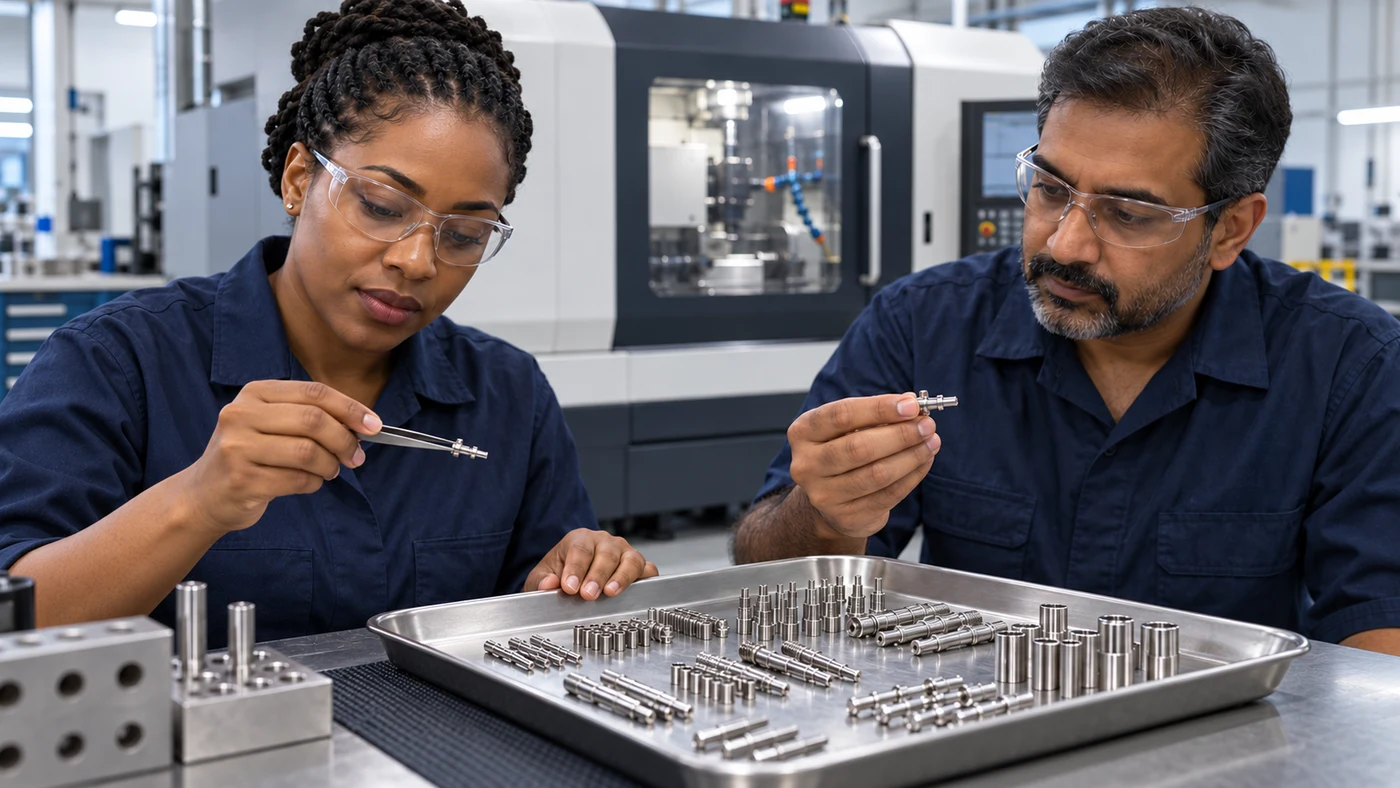
Watch: Swiss Machining Cutting Oils & Coolants
Swiss Machining: A Complete Fluid Application
What should you look for in a Swiss machining cutting oil? Start with more than the name on the drum. Swiss-type machines can combine turning, drilling, milling, threading and parting in a compact work area. The fluid must support that complete cycle and the requirements of the actual machine. Small components can also make chip handling, tool access and part cleaning especially important. In this QA Lubricants guide, we explain sliding-headstock machining, the guide bushing, fluid selection and the checks behind a useful recommendation. QA has coolant and oil options for metalworking applications. We will match candidates to the machine, materials and performance target rather than assume that one product suits every Swiss lathe. Our original photos and diagrams illustrate principles; they are not setup instructions or evidence of a particular customer's results.
Sliding Headstock & Guide-Bushing Support
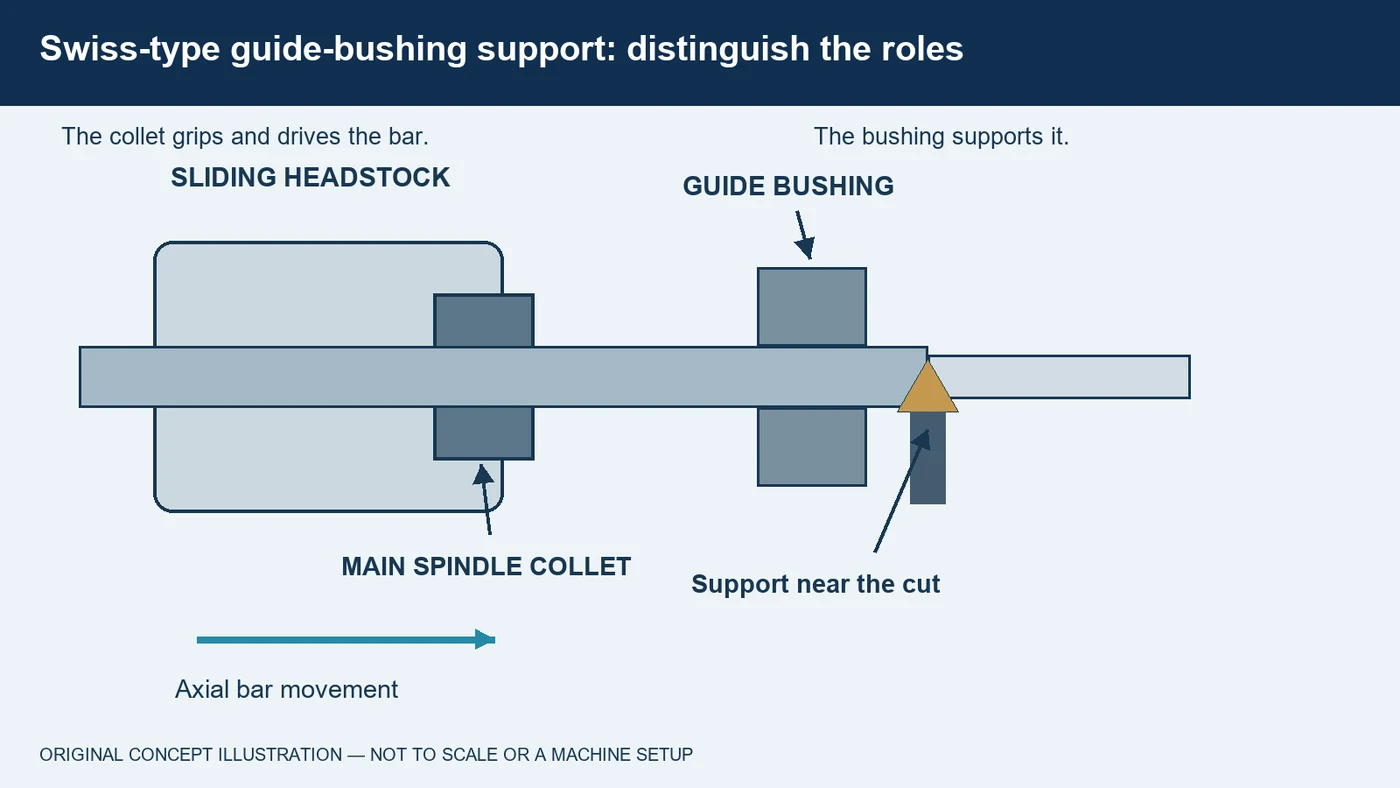
In a traditional guide-bushing Swiss setup, the headstock moves the rotating bar axially while cutting tools work close to its support. The main spindle collet grips and drives the stock. The guide bushing supports the bar near the cutting area; it is not simply another name for that collet. Keeping the working region close to support helps when producing slender features. A sub spindle may receive the component for additional work, and driven tools can add operations beyond ordinary turning. Machine configurations vary. Some can operate without a guide bushing for appropriate parts. Do not transfer guide-bushing adjustments, stock requirements or operating limits from a different model. Bar dimensions, straightness, surface condition and the specified bushing arrangement belong in the process review. A cutting-oil change will not correct an incorrectly prepared bar or unsuitable support setup.
Confirm the Approved Fluid System First
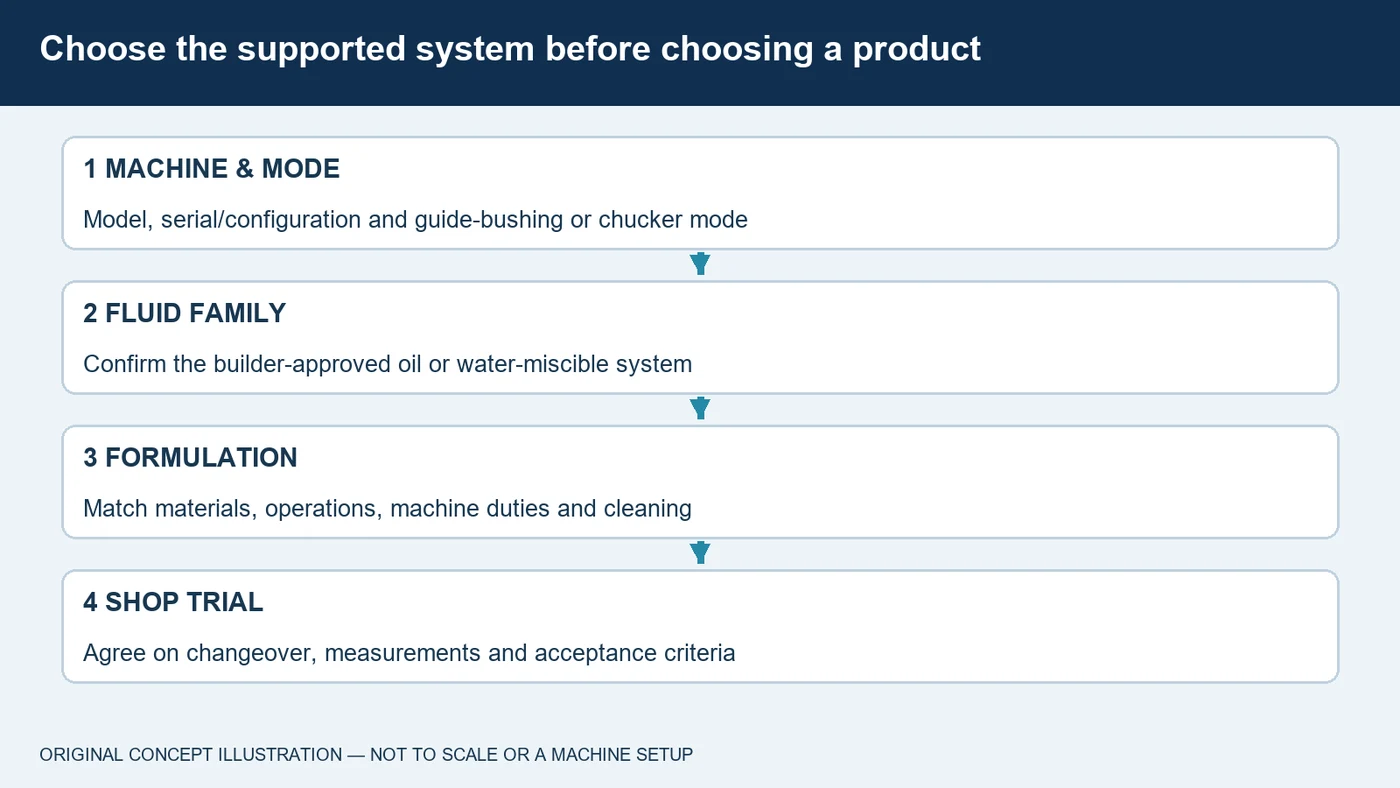
Straight cutting oils are used without mixing with water and are common candidates for Swiss-style machining. But the exact machine configuration still comes first. Builders publish model-specific requirements, and some configurations expressly restrict water-soluble fluids. Never assume that a newer machine, a similar model or a different shop's installation has the same approval. Confirm the current manual and ask the builder before changing fluid families. Also determine whether the cutting fluid has any intended machine-lubrication duties in that system. A general claim that an oil lubricates guide bushings or other machine parts does not replace the manufacturer's instructions. Water-miscible coolant is a separate formulation and maintenance choice where the equipment permits it. Select the supported system before comparing products within it. Do not dilute a neat oil with water or an unapproved solvent to make it flow differently.
Viscosity, Lubricity & Material Compatibility
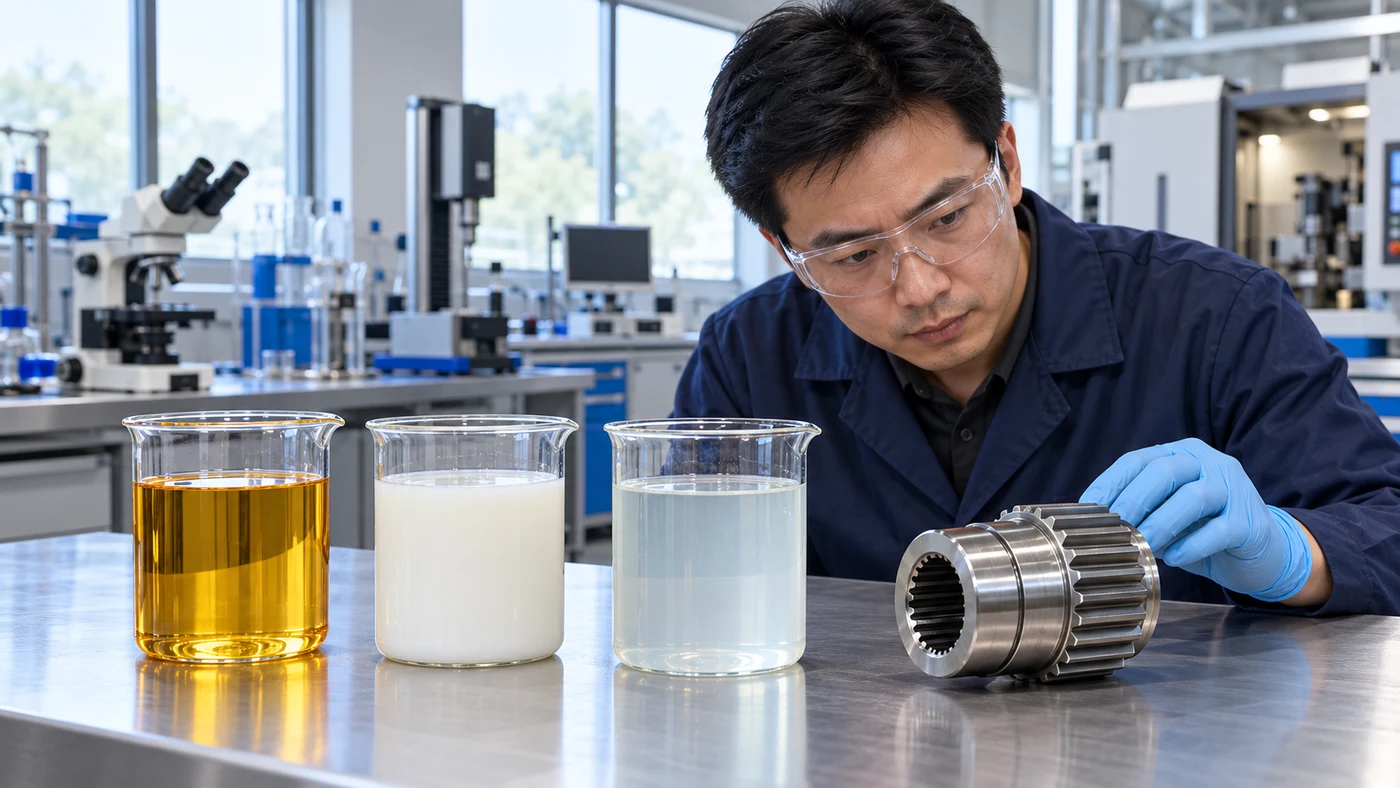
Viscosity influences how an oil flows, but it is only one part of selection. A thinner oil is not automatically the best oil for every Swiss process, and a thicker oil is not automatically more capable under load. Evaluate the formulation's cutting performance alongside delivery, machine compatibility and the intended operations. Stainless steel, free-machining steel and titanium create different questions from aluminum or brass. Identify the exact alloys and any restrictions on surface residues. Copper-containing materials deserve particular attention to staining and active-sulfur compatibility. Include the downstream washing process and the acceptable condition of finished parts. Manufacturer selection guides distinguish materials, application severity and viscosity rather than providing a single universal grade. QA can use those same application details to narrow suitable coolant and oil candidates without promising that one family name guarantees performance.
Chip Control in a Compact Work Zone
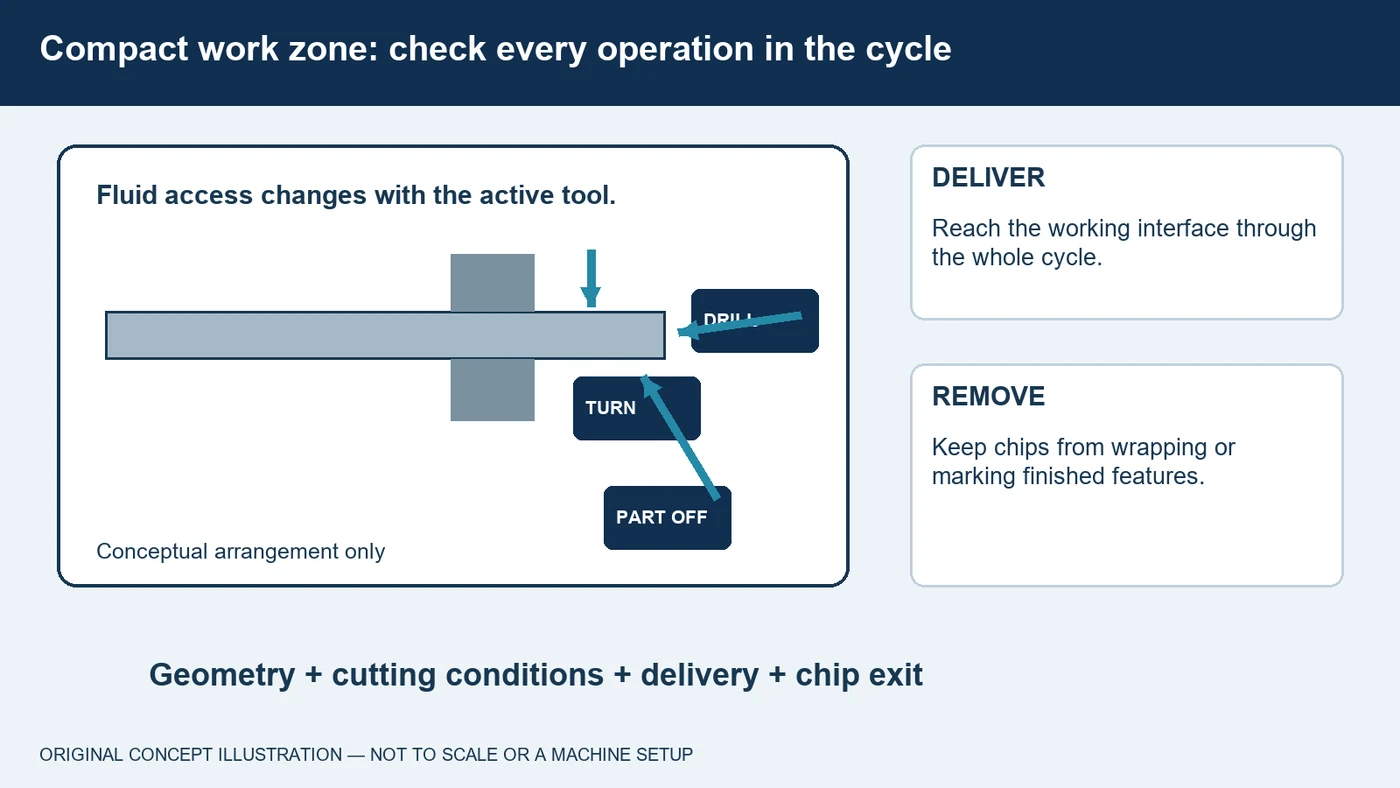
Several tools may share a small working area, so a nozzle that reaches one edge may miss the next operation. Review the complete cycle, including drilling, cross work, threading and parting. Confirm that the intended fluid reaches each working interface and that chips have a way out. Long chips can wrap around the component or tooling, while trapped chips can mark a finished surface. Tool geometry and cutting conditions remain part of chip control. Some machines provide supported programming features that influence chip breaking, but they must be used according to the builder's instructions. More pressure alone is not a universal cure. The pump, filters, hoses, connections, holders and outlets must be rated for the proposed service. Inspect and correct delivery only through the machine's approved safe procedure, with moving equipment stopped as required.
Maintain a Clean, Consistent Fluid System
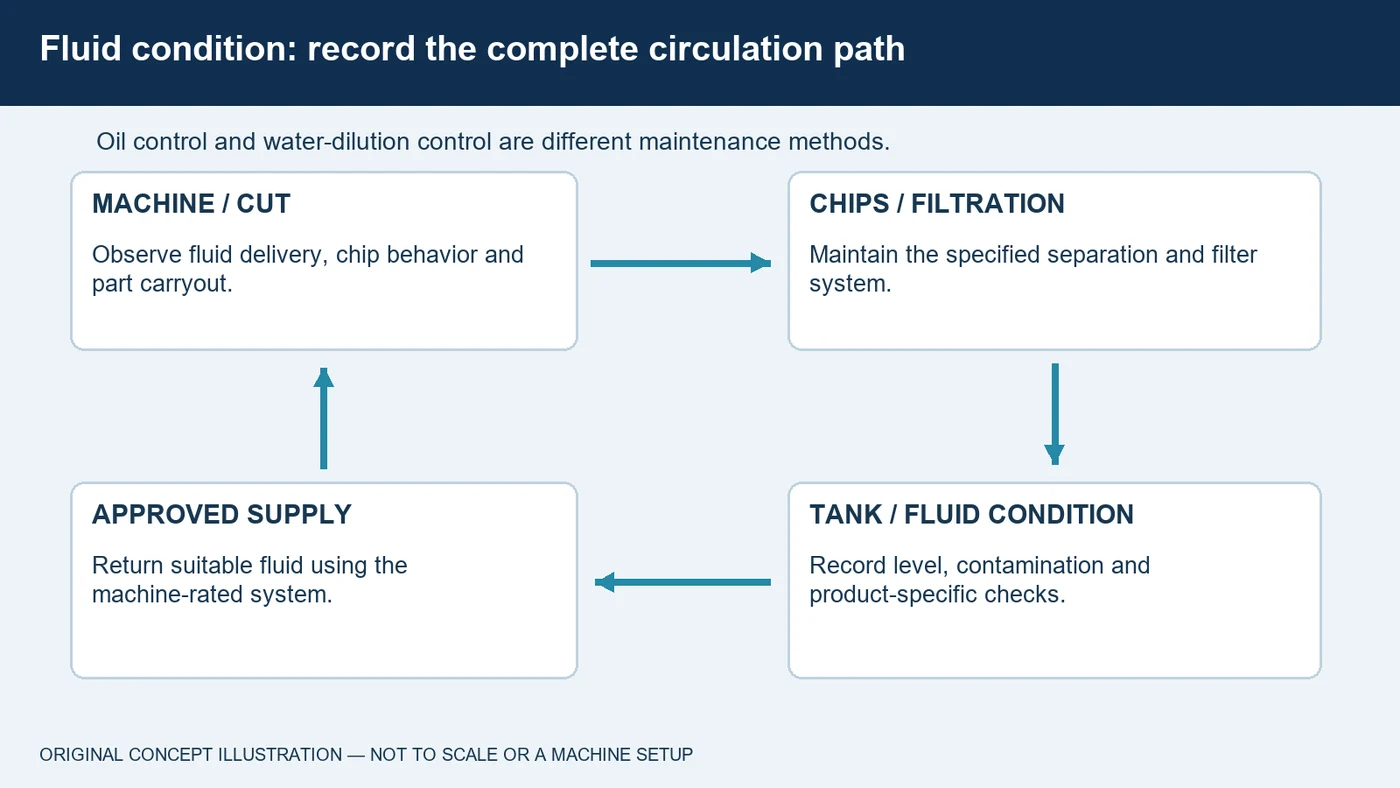
A suitable fluid needs a maintained system. Record contamination, filter condition, tank level and the condition of the oil or coolant using the checks specified for the product and machine. Fine chips should not simply recirculate into the next operation. Review carryout on chips and parts when investigating consumption, and use only approved recovery and handling methods. Mixing a new oil with an unknown residue can complicate a trial, so agree on the changeover procedure with the suppliers. If the machine is approved for water-miscible coolant, follow the selected product's concentration and water-quality instructions and use the correct refractometer factor. Neat oil does not use that water-dilution control method. Maintain the enclosure, extraction and any fire-protection provisions required for the equipment and fluid. Do not treat a flash-point number as a guarantee that a process cannot ignite.
Check Support, Tools & Fluid Before a Change
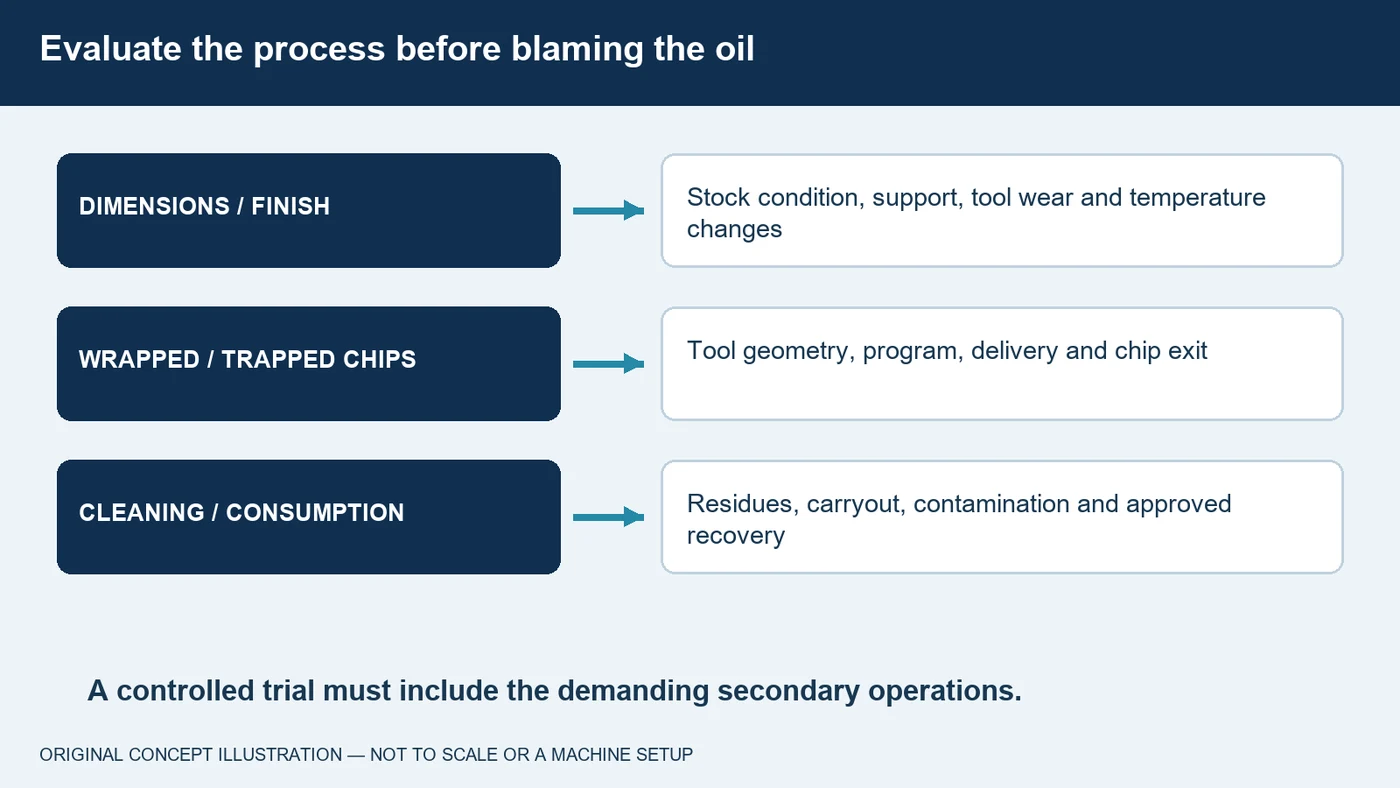
If dimensions drift or a surface becomes marked, record when the symptom appears and what changed. Stock condition, support, tool wear, chip contact and the program can each matter alongside the fluid. A long, slender feature is a different stability problem from a short part produced in guide-bush-less mode. Compare the actual setup with the machine and tool guidance rather than trying to solve every issue with an additive or a different oil viscosity. Before a fluid trial, establish a stable baseline and define the acceptable outcome. Track dimensions, finish, tool life, chip evacuation, part cleaning and consumption under comparable conditions. Include the demanding secondary operations rather than judging the trial only by the easiest turning pass. The useful result is repeatable acceptable production, not one attractive sample or an unsupported percentage improvement.
Build Your Swiss-Machining Fluid Recommendation
To discuss a Swiss machining fluid with QA Lubricants, send the machine model and configuration, guide-bushing or guide-bush-less mode, bar material and condition, and every operation in the cycle. Include the current oil or coolant, delivery arrangement, filtration and part-washing process. Tell us the problem you want to solve: wrapped chips, poor finish, dimensional variation, tool life, residue or high fluid consumption. Share any customer requirements that restrict the process or additives. QA has coolant and cutting-oil options and can help evaluate candidates with the machine and tooling requirements in view. We will confirm application guidance before recommending a controlled shop trial. Find more metalworking guides at QA Lube dot com, or call one, eight seven seven, eight seven seven, six two two one. Thank you for watching this QA Lubricants Swiss machining guide.
Fluid selection by material
Use these as evaluation questions, not blanket product approvals.
| Material | What to evaluate | What to confirm |
|---|---|---|
| Stainless steel | Evaluate lubricity, tool wear, chip control and the complete operation sequence. | Exact grade, hardness, micro-drilling or threading demands and residue restrictions. |
| Carbon, alloy and free-machining steels | Match cutting performance and chip evacuation to the actual grade. | Bar condition, heat treatment, guide-bushing configuration and finish targets. |
| Aluminum | Evaluate nonstaining lubrication, edge adhesion and dimensional stability. | Alloy and bar condition; confirm machine approval before considering a water-miscible fluid. |
| Brass, bronze and copper | Evaluate nonstaining compatibility and the part-cleaning process. | Active-sulfur compatibility and any restrictions on additives or surface residues. |
| Titanium and nickel alloys | Evaluate a specialist formulation and reliable delivery to each active tool. | Machine/tool instructions, customer process requirements and controlled-trial evidence. |
| Mixed-material production | Confirm every alloy and operation in the shared system. | A product suitable for one metal is not automatic approval for all the others. |
Questions about Swiss-type machining fluids
Does every Swiss-type lathe use straight cutting oil?
Straight oil is common in Swiss-style applications, but fluid approval depends on the particular machine and configuration. Some configurations have explicit restrictions. Check the current manual and machine builder before changing fluid families.
Is the guide bushing the same as the main spindle collet?
No. In a guide-bushing setup, the main spindle collet grips and drives the bar; the guide bushing supports it close to the cutting area. Guide-bush-less modes are also available on some machines.
Should Swiss cutting oil always be the lowest possible viscosity?
No. Flow, machine requirements, lubricity, additive chemistry and oil condition all matter. Confirm a suitable viscosity with the machine and fluid suppliers instead of selecting on thinness alone.
Can a different oil eliminate wrapped chips?
Not by itself in every case. Inspect tool geometry, cutting conditions, chip evacuation and any supported chip-control programming before blaming the oil.
Can QA recommend a fluid for our Swiss machine?
QA has coolant and oil options. Provide the machine model, configuration, alloys, operations, current fluid and performance issue so candidates can be evaluated for a controlled trial.
Discuss your application with QA
Read this guide in the QA online store
QA Lubricants has coolant and oil options. Send us the operation, alloy, hardness, tooling, current fluid and the problem you want to solve.
Discuss My ApplicationShop Water Diluted CoolantsShop Straight Cutting OilsTechnical references
- Citizen Machinery: guide-bushing, coolant and machine accessories
- Citizen Machinery: guide-bush-less operation and chip-breaking example
- Tsugami: Swiss-turn machine configurations
- Tsugami America: historical S205/S206 model brochure, configuration-specific fluid restrictions
- QualiChem: straight oils and Swiss-style applications
- QualiChem: straight-oil selection guide
- Hangsterfer's: cutting oils and machine compatibility considerations
- Sandvik Coromant: turning chip-control troubleshooting
Original educational content and illustrations. Confirm current machine, tool and fluid instructions. Trademarks belong to their respective owners.